
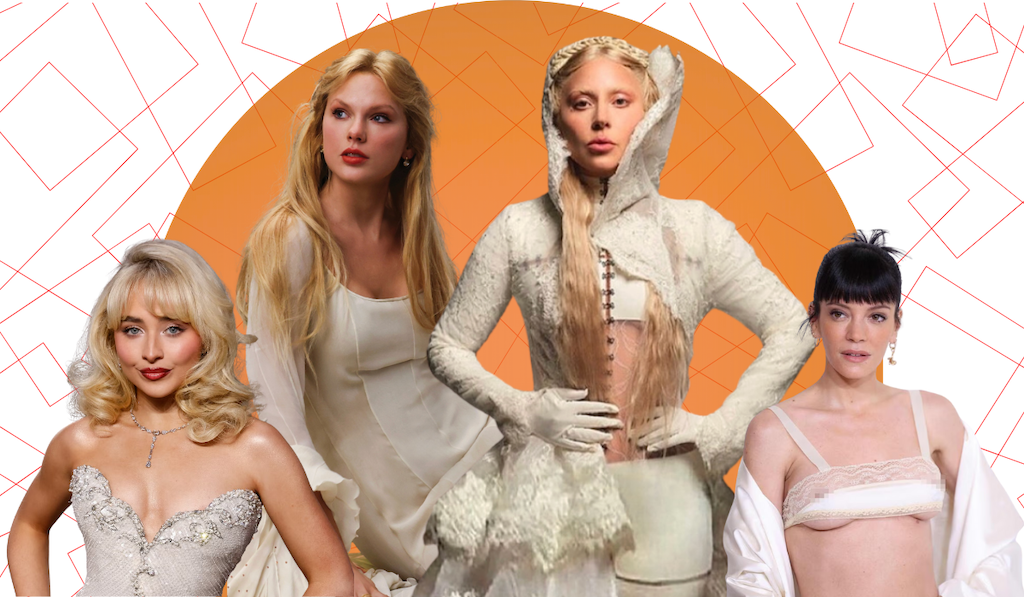
In 2025, music didn’t always announce its politics outright. The megaphone was still there—it just didn’t need to be at maximum volume all the time.
Who knew a 2009 mash-up could feel this prophetic?
DJ Earworm’s United State of Pop once promised a world where pop, dance, rock, hip-hop and electronic beats would collide into something new. Fast-forward to 2025, and that collision became the norm, driven by women who refused to stay in one lane. That future flow didn’t arrive quietly. It arrived dressed arrestingly in pop carried by artists who knew exactly how to command attention — and keep it.
Pop in 2025 sealed the deal not through volume, but through range. This was a year defined by women driving the charts, shaping sound and expanding the boundaries of what mainstream music could hold. The genre stretched outward and allowed itself to evolve, absorbing nostalgia, a global narrative, theater and spectacle, all while remaining unmistakably dominant.
Ladies and gentlemen, Her:
The continuous rise of the female pop star
At the center of it all were female pop stars who set the pace for the year. According to Billboard 2025 summaries, Taylor Swift and Sabrina Carpenter emerged as the top female artists of the year. Taylor also bagged one of the top spots on Spotify’s leading global artists and the top-ranked female artist in the US. Importantly, this was the year where most artists finally found their sound. Take Sabrina Carpenter for instance. Though she finally broke the mold after a decade in the industry, I believe “Man’s Best Friend” was her trademark record over “Short N’ Sweet.”
Sabrina’s decision to refine her voice and aesthetic, folding disco, Dolly Parton and ‘70s pop influences into the album did wonders for her numbers. “Man’s Best Friend” went on to debut at #1 on the Billboard 200 and simultaneously broke Spotify’s record for most streams in a day by a female artist in 2025 and achieved platinum status thereafter.
Tate McRae’s steady ascent to pop star status was cemented in 2025, proof that re-invention can sometimes be contrary to success. She instead relied on her command of the stage and her dance prowess throughout her “So Close To What” tour, revving her engines to shine bright in the spotlight.
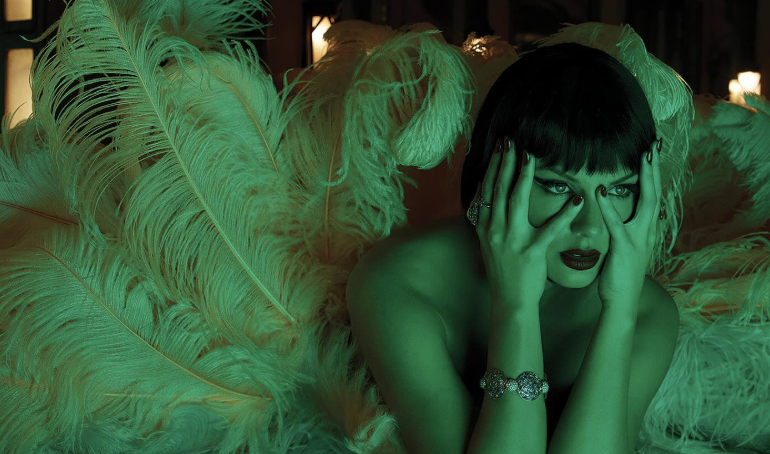
And Taylor Swift, polarizing as ever, remained the industry’s gravitational center. “The Life of a Showgirl” sparked discourse by design, but even in its divisiveness, it reaffirmed Swift’s singular position—that she is an artist capable of holding every genre in the palm of her hand and thrusting it into one living archive. Compared to the quieter output of former chart toppers, the contrast was clear: pop’s center of gravity in 2025 was firmly female.
Related story: Five questions Taylor Swift’s ‘End of An Era’ docuseries finally answers
Related story: Disney+ releases first three episodes of ‘The Beatles Anthology’
Related story: Rap rules, new categories debut, and Korean acts shine at the 2026 Grammy nominations
Related story: The Taylor Swift effect: Crowds flock to Museum Wiesbaden in Germany to see Friedrich Heyser’s ‘Ophelia’
Music on the megaphone:
The pulse behind the playlist
Still, the year did not open gently—and for good reason. Hiphop set the tone in the most brilliant way possible, thanks to one Kendrick Lamar who used his performance at the Superbowl as a sounding board for his album “GNX,” political commentary (and to hilariously dig on his industry nemesis and fellow rapper Drake). He traded the flash for fumes, and his bars were more than standard. In a moment watched by millions, Kendrick reminded audiences that rap remains one of the most powerful vessels for commentary in American music. It wasn’t about presence, intention and timing. While pop ruled the year’s body, hiphop opened its pulse.
But Kendrick was not alone in using music as a sounding board. Commentary arrived in quieter, sharper forms as well. Lily Allen returned to the conversation with the same incisive wit that once defined her in “West End Girl,” proving satire still cuts deepest when it’s precise. Pop’s perennial female savant Lorde continued to interrogate power, femininity and visibility in “What Was That” as a reminder to listeners that what’s withheld can be just as political as what’s declared.
Do you remember the time:
Music as nostalgia
One of the most striking through lines of 2025 was nostalgia as a tool, not a crutch. Artists were not looking backward to replicate the past, but were reshaping it. Sabrina was a classic example of that, having borrowed from ABBA and soft-rock eras to build on her playfully naughty brand. Spanish artist Rosalia, on the other hand, widened the room entirely, weaving classical motifs, religious themes and multi-lingual verses into her album “LUX,” proving that foreign language isn’t an aesthetic but a form of expression.
And in Lady Gaga’s case, nostalgia for her own music proved to be successful as fans (aptly called Little Monsters) were thoroughly elated with her return in “MAYHEM.” Here, pop spectacle reached its delicious apex and a thunderous return to form, re-asserting her position as one of pop music’s keyholders to its kingdom. Ariana Grande’s venture into musical theater latched onto her childhood dream of becoming Glinda, and how her process in adapting the character alongside Cynthia Erivo’s Elphaba brought Broadway into the mainstream conversation, collapsing the divide between stage and chart.

The stage as spectacle:
The era of live music
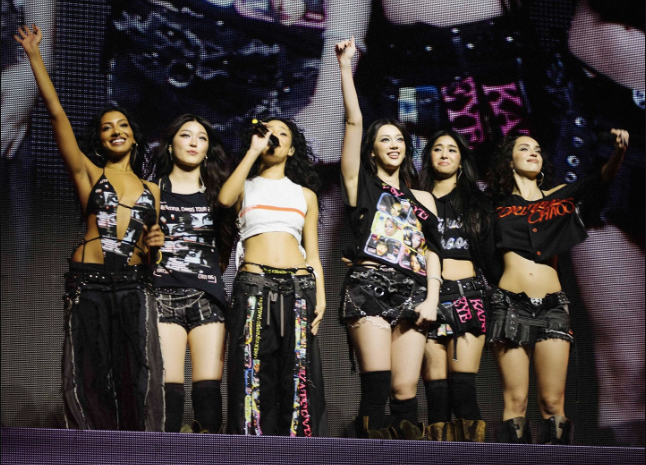
Live music, too, reclaimed its status as a proving ground. Tours were not just promotional cycles, but were cultural resets. Groups like KATSEYE demonstrated how quickly fandoms can harden into devotion when nurtured onstage. Demi Lovato’s appearance during the Jonas Brothers’ tour was not mainly a nostalgic pull. Rather, it was a reminder that the stage remains one of the most powerful places for reclamation and return — a statement that the dream is definitely not over. Concerts offered artists a chance not just to perform, but to reintroduce themselves.
The slow burn:
Where taste had a moment
And despite persistent narratives that one artist’s dominance blocks others from shining, 2025 quietly disproved that myth. Olivia Dean’s Man I Need from “The Art of Loving” was proof that warmth, craft and patience proved ‘easy to fall in love with.’ RAYE’s continued rise to main star reinforced the idea that emotional honesty and strong pipes can thrive alongside spectacle. There was room, even under the brightest spotlight, for artists operating at a different temperature. More importantly, there was space for everyone to make their mark.
Through it all, Taylor Swift remained a constant, not as a gatekeeper, but as an axis. Her genre-fluid career has invited comparisons here and there, but has also simutaneously given way for others to exist in parallel to her, not in opposition.
“The Life of a Showgirl” did not need to be universally adored to be effective; it simply needed to exist as part of a longer conversation about longevity, reinvention and the very thing she spent her whole life trying to put into words: love.
If 2025 proved anything, it’s that women weren’t just busy — they were in control. This was not a year defined by one sound or one star, but by the collective force of artists who expanded pop’s vocabulary while keeping its heart intact. Fine, fresh and undeniably femme, 2025 didn’t just sound good, it sounded intentional.
Who runs the world? You already know the answer to that one.
Related story: Mariah and me: One Lamb’s lifelong devotion and obsession
Related story: Madonna returns to Warner Records, teases 2026 album release
Related story: Animated idols, real records: How ‘KPop Demon Hunters’ took over the music charts