


Stripped of the traditional set and movement, the concert format of Les Misérables World Tour Spectacular allows for a greater appreciation of the musical.
It was in 1862 that Victor Hugo wrote Les Misérables as an attempt to bring attention to the social injustice and inequality existing in France at the time. Fast forward to 1979, when French writer Alain Boublil and composer Claude-Michel Schönberg began work on a concept album, in French, inspired by Hugo’s 900-page tome.
Boublil and Schönberg’s work was staged as a musical the following year at the Palais des Sports in Paris. But it would be in 1985, when the English version of Les Misérables opened in London, that it would find its place among the iconic productions in musical theater history.
At its core, Les Miz is a veiled reminder of how societal woes have barely changed over time. Inequalities continue to exist, only in varying forms and lasting impact, and the human struggle against them continues—everywhere.
Forty years later, the show carves a new path for itself as a touring concert production—one that has even hardcore Les Miz fans finding a deeper appreciation for both the music and the story. And Manila audiences are not shy in showing it, as Les Misérables World Tour Spectacular, which runs until March 1, has been met nightly with standing ovations and joyous cheers at curtain call. Every bit of it well-deserved.
Yes, we were all swept up in the music and the spectacle of it all, but if you look even closer, the concert musical lands because it connects with the part of us that believes there is a “new world to be won”—the revolutionary heart that is beating within all of us, whether we want to admit it or not.
An acting tour de force

Central to Les Miz is Jean Valjean, just released after 19 years of hard labor for stealing a piece of bread. An unexpected act of kindness gives him a strong moral compass that changes the trajectory of his life.
Argentinian actor Geronimo Rauch brings to life a Valjean who is strong-willed, yet every note shows him teetering on the edge of broken. You feel the lamentation in his voice as he sings What Have I Done?, or when he realizes his hand in Fantine’s fate, as he begs for forgiveness for the choices he’s made for the sake of love. Rauch sings Bring Him Home—a song that has resonated with him more since becoming a father—as a personal prayer, one that he sends out for someone who may need to hear it. Yeah, we all felt that.
Jeremy Secomb steps in as Valjean’s nemesis, Javert. The Australian actor’s towering presence shows a man consumed by madness, carefully hidden under the heavy coat of a police captain. As Valjean continues to elude capture, the obsession builds almost to a crescendo. But it is when the illusion falls apart, as Javert is shown great compassion, that Secomb delivers his finest onstage moments. Disheveled and stumbling, we see a man ripped apart by pride, defeat, and anger—and he sings it as such. Splendidly so, and the audience was not shy in letting him know.
That said, Rauch and Secomb together in a scene is a moving display of intention and storytelling, as the push and pull between Valjean and Javert breaks through the concert setting and lack of dialogue. Even their costumes’ color palettes—with the former in neutral shades and the latter in an ominous shade of black—echo this narrative.
Related story: 2025 in theater: How Filipinos deepened their love affair with musicals
Related story: REVIEW: Stay for the music and the nostalgia at ‘The Bodyguard’
A French story with a side of Filipino talent
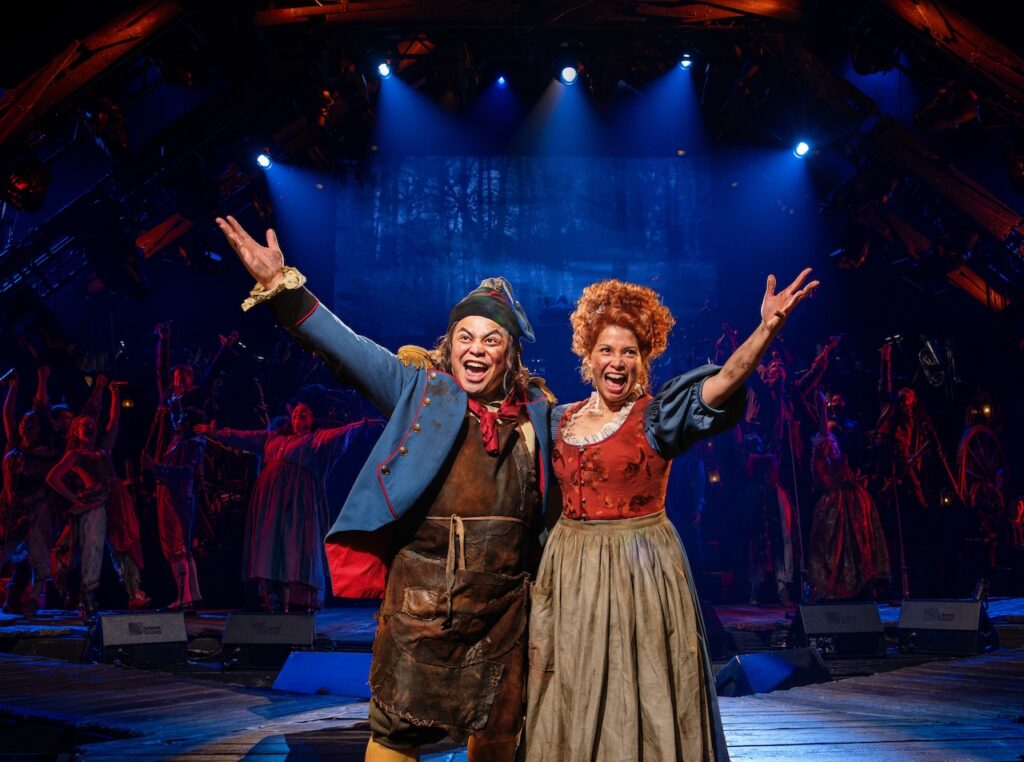
It’s been said over and over again and bears repeating: Filipino actors have gained quite a foothold in big-ticket shows all over the world. Make that a Manila staging, and they become a major draw. Les Miz came with a full slate, which had Lea Salonga—who returns to the show as the innkeeper’s wife, Mrs. Thenardier—saying, “When I saw all four of us Filipinos together on those pages, as leads at that, I was like, ‘Wow, just wow.’” It is quite a feat, especially for one of musical theater’s pillar productions, becoming a source of Filipino pride.
Playing opposite Lea is Red Concepcion, who gave the sleazy Thenardier a modicum of dignity, making him a little less hatable. He kept it a hair shy of comical but gave us a peek into the inner (and convoluted) workings of the innkeeper’s mind. He delivered some of the best moments of the show.
On the other hand, it was refreshing to see Lea take on a more comedic role and fully immerse herself in it. Her playfulness as an actress shows through when playing offbeat characters, much like she did as the witch in Into the Woods. As a pair, and dressed in kooky costumes, Lea and Red played up the camp, giving the show much-needed moments of levity. Lea did playfully declare that in this production, “I don’t die! We both don’t die,” having previously played both of the show’s tragic heroines, Fantine and Eponine, on Broadway and the West End.
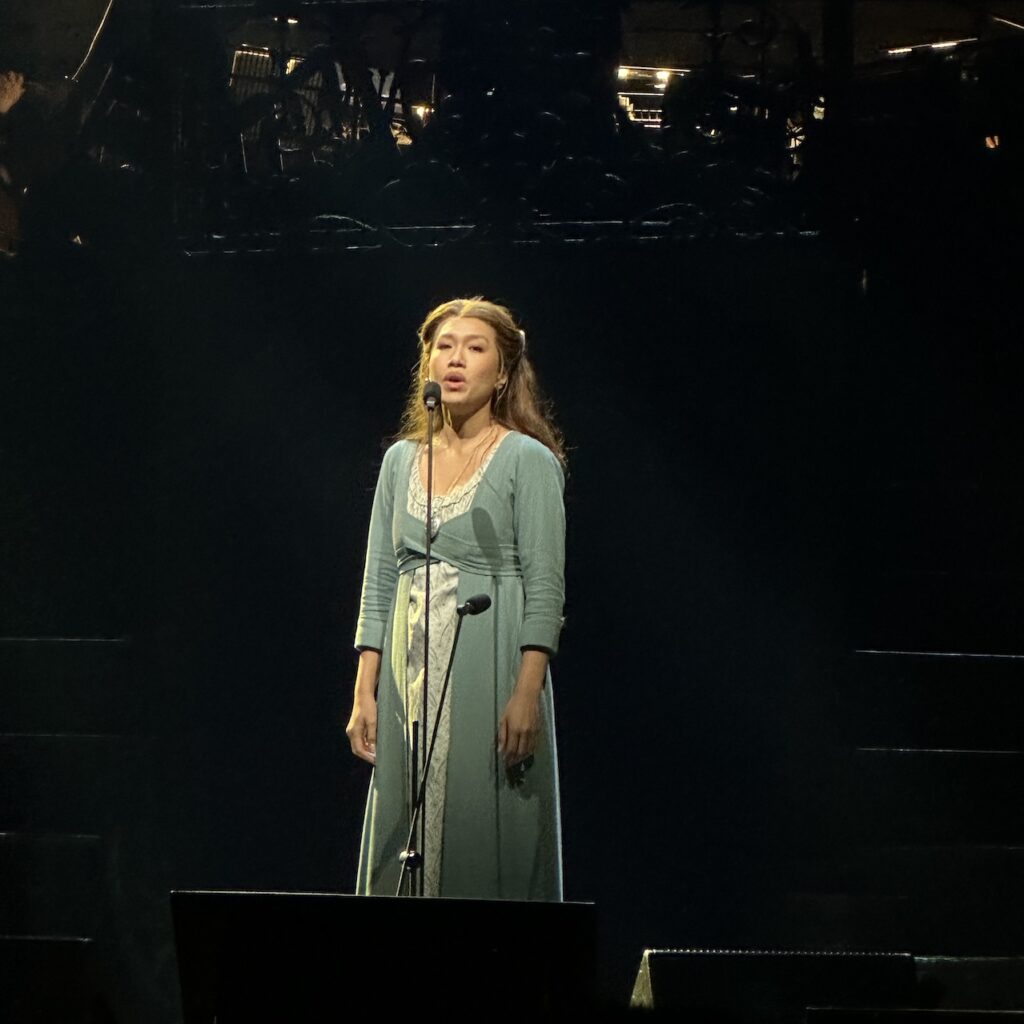

The role of Fantine in this production marks Rachelle Ann Go’s second return to Manila, after her appearance as Eliza in Hamilton in 2023. She carries her heart on her sleeve while singing the Les Miz equivalent of a power ballad. In parts, it did feel like she was singing it in that way, too. Rachelle still moved us to tears, nonetheless. Rounding out the Fab Filipino Four is another Miss Saigon alum, Emily Bautista, who gave a feisty take on Eponine—street-smart and headstrong, with a side to her that goes beyond the girl with a broken heart. It was an interesting performance to watch, except it gets lost in translation as she sang On My Own, which ran short on melancholy and despair.
Lea, Rachelle, and Emily share parallel paths, having been in different generations of Miss Saigon and Les Miz. Red made his rounds in the local theater scene before making his Broadway debut in 2024 as Amos Hart in Chicago, becoming the first Filipino to play the role—which makes this homecoming a big win from both sides of the stage. Yet while all this success is great and a testament to Filipino artistry, it does beg the question: do we, as an audience, really need to wait for these actors to find success on global platforms like Broadway and the West End to be recognized locally for what they can do as performers?
A revolutionary heart
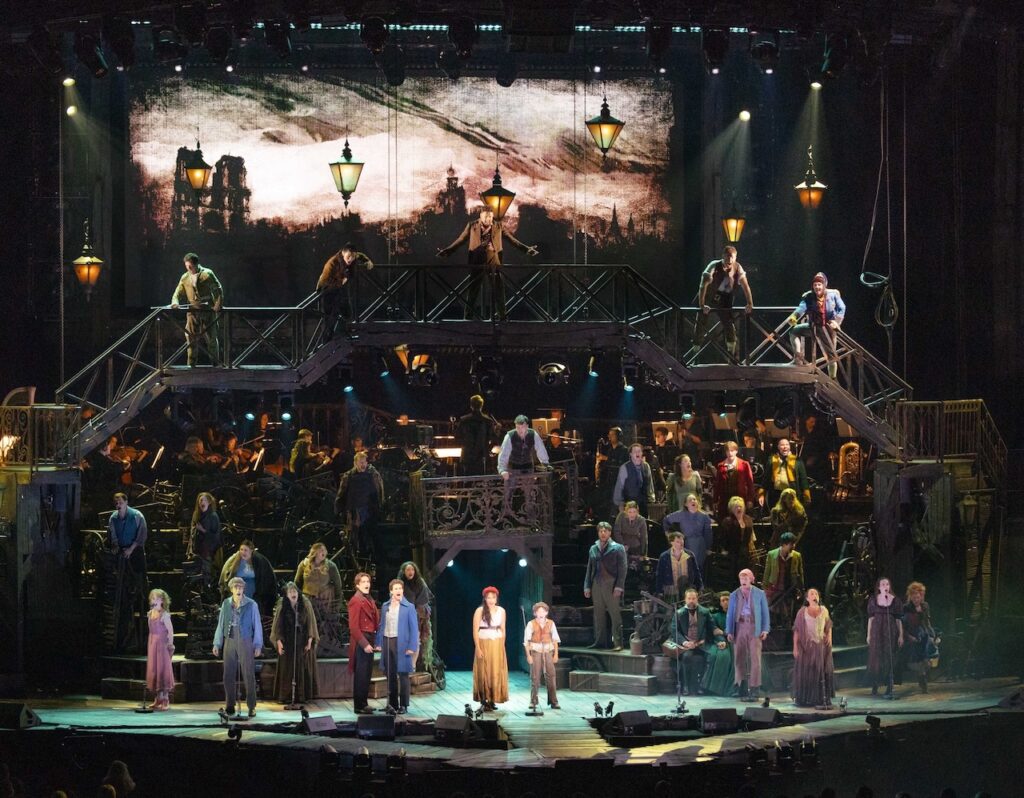
Les Misérables is a story first written as a novel over 150 years ago, inspired by the June Rebellion of 1832, which Hugo was said to have witnessed firsthand. Watching its musical iteration can feel like a French history lesson in 3D—history lesson being the operative phrase. It digs deep into universal themes of love, oppression, and an idealistic hope for a free world.

In what has become the musical’s centerpiece, Enjolras (Harry Chandler), Marius (Will Callan), and their classmates take their idealism to the barricades, fighting for a sea change in France. Rising up in revolution, even in the face of death, they hope the masses will rally alongside them. As they sing Red and Black and Do You Hear the People Sing?, you almost believe they will emerge victorious. But it is in Drink With Me (To Days Gone By) that their fears surface, while Empty Chairs at Empty Tables rings heavy with regret.

At its core, Les Miz is a veiled reminder of how societal woes have barely changed over time. Inequalities continue to exist, only in varying forms and lasting impact, and the human struggle against them continues—everywhere. Juxtapose that narrative into the Philippine setting and the endless cycle of corruption and injustice that plays out in the daily news, and it lands. Hard. It puts our collective frustration on full display, and we are given permission to grieve quietly in our seats for our country and our people.
Stripped of the traditional set and movement, the concert format of Les Misérables World Tour Spectacular allows for a greater appreciation of the musical. It draws your focus deeper into the music and lyrics, inviting you to read between the lines and see the story written there. There is much more to be discovered, no matter how many times you’ve already seen it or how well you can sing the songs forward and back—hence the wellspring of emotions and tears from the drop of the conductor’s baton at the first notes of the anthemic One Day More.
Perhaps this is the reason Les Misérables, even in this concert iteration, has withstood the test of time: because it holds a deeper story still to be discovered, defined by the space where the society we live in shifts with the passing of time. Because it holds space for our revolutionary hearts to hope for better days ahead.
Les Misérables: The World Tour Spectacular runs until March 1 at The Theatre at Solaire.
Related story: REVIEW: The fever dream that is ‘Pingkian’
Related story: One day back at the creek
Related story: REVIEW: ‘Dear Evan Hansen’ is a study in loneliness in a supposedly connected world