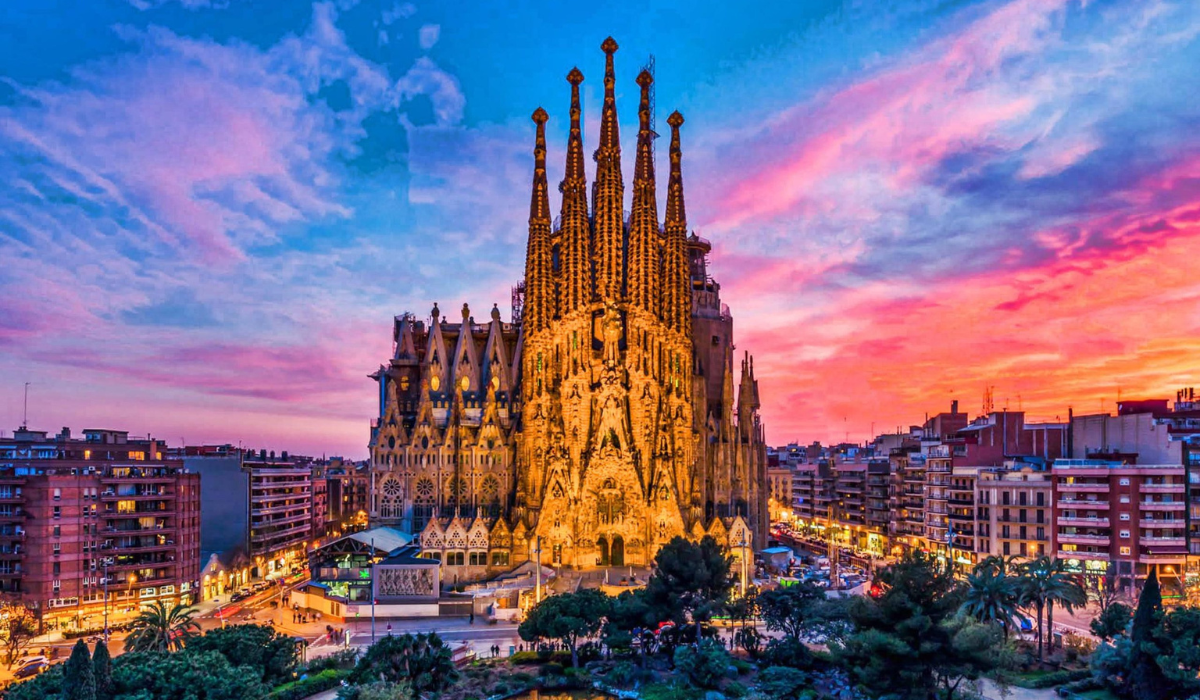

After almost a century and a half of Sagrada Família’s construction, the exterior structure of the tallest church in the world was finally completed last week.
For generations, the Basílica de la Sagrada Família existed in a state of becoming—its towers punctuated by cranes, its silhouette unfinished against Barcelona’s sky. Now, after 144 years of continuous construction, the exterior of the world’s tallest church is finally complete, marking a historic turning point not just for the basilica, but for the city itself.
The milestone arrives at a moment when Barcelona is preparing to step onto an even larger global stage: its designation as the UNESCO World Capital of Architecture 2026, a year-long recognition of how the city’s built environment continues to shape culture, identity, and the future.
Together, these two developments tell a deeper story—one of endurance, imagination, and a city that has spent more than a century building its legacy in stone, glass, and light.
The completion of a 144-year promise
Construction on the Sagrada Família began in 1882 under the vision of Catalan architect Antoni Gaudí, whose distinctive fusion of Gothic tradition and organic modernism would transform the project into one of the most recognizable structures in the world. When Gaudí died in 1926 after a tragic accident, less than a quarter of the basilica had been completed.
Nearly a century later, his vision has finally reached a defining milestone.
The basilica’s tallest tower—dedicated to Jesus Christ—has now reached its full height of 566 feet (172.5 meters), officially making it the tallest church on Earth. At its peak stands a monumental four-armed cross clad in glass, stone, and white enameled ceramic, designed to catch and reflect light at all hours. Built in Germany and assembled in Barcelona, the cross was installed piece by piece, its final section lifted into place by crane in a moment symbolic of both closure and continuation.
Gaudí envisioned the structure as something alive—an architecture shaped by nature, faith, and time. The cross itself contains a spiral staircase and windows that allow light to move through its interior, embodying his belief that sacred spaces should feel illuminated from within.
Though finishing touches, sculptures, and interior elements are still scheduled for completion over the coming years—with full completion targeted for 2034—the removal of exterior construction marks the first time in over a century that visitors can see Gaudí’s masterpiece without interruption.
For Barcelona, it is not just the completion of a building. It is the fulfillment of an idea carried across generations.
A city defined by architecture—and still renovating
The timing could not be more fitting. In 2026, UNESCO and the International Union of Architects will formally recognize Barcelona as the World Capital of Architecture after being designated the title in 2023, placing the city at the center of a global conversation about how architecture shapes human life.
Awarded every three years, the designation acknowledges cities that demonstrate architecture’s power to influence cultural identity, sustainability, and urban evolution. For Barcelona, it affirms something locals have long understood: architecture is not simply part of the city—it is the city.
From Gaudí’s flowing facades to contemporary urban redesigns, Barcelona has built its reputation through structures that blur the line between engineering and art. But the recognition goes beyond famous landmarks. Over the course of 2026, more than 1,500 events—including exhibitions, guided walks, workshops, and public installations—will invite residents and visitors to engage with the city’s architecture in new ways.
Rather than focusing solely on iconic sites like the Sagrada Família, the program aims to shift attention toward lesser-known neighborhoods, highlighting how architecture continues to shape everyday life across the city’s ten districts.
This decentralization reflects a broader philosophy: that architecture is not frozen in history, but constantly responding to social, environmental, and cultural change.
Related story: 6 hidden gems in Barcelona for dining, drinking, and meeting people
Related story: In Spain, three things are certain: food, wine, and siesta
Gaudí’s legacy at the center of a new era
The completion of the Sagrada Família’s exterior coincides with the centenary of Gaudí’s death—a symbolic convergence that bridges the past and the future.
During the World Capital of Architecture year, several of Gaudí’s UNESCO-listed works—including Casa Milà, Casa Batlló, Park Güell, and the Sagrada Família itself—have already been illuminated in blue to mark the occasion. These buildings, once radical departures from conventional design, now stand as foundational pillars of Barcelona’s global identity.

Yet the focus of 2026 is not only on preservation, but on progression.
Initiatives such as the “10 Blind Walls Competition” will transform overlooked building facades into vertical gardens and public artworks, while programs like “The City We Want” invite younger generations to imagine how urban spaces can evolve to meet future needs.
Even architectural walking tours will extend beyond tourist-heavy areas, encouraging visitors to explore districts like Nou Barris and Vallvidrera—places where architecture continues to unfold in quieter, more personal ways.
Architecture as a living conversation
What makes Barcelona unique is not just the presence of monumental structures, but the way architecture exists as part of everyday life. Buildings are not isolated symbols—they shape how people move, gather, and experience the city.
The Sagrada Família itself embodies this philosophy. Funded entirely by private donations since its inception, its slow, deliberate construction reflects collective participation across generations. Each phase of its creation has been shaped by changing technologies, shifting artistic interpretations, and the persistence of belief in Gaudí’s vision.
Even now, as its exterior stands complete, the basilica remains unfinished in spirit—a reminder that architecture, like cities, is never truly final.
Related story: Top 3 European countries to get a Digital Nomad Visa
Related story: LIST: 6 best destinations for outdoor and architecture lovers