

This platform repurposes waste, realizing sustainability and shifting the conversation toward contemporary tech.
The story of civilization is scripted in its substances: cotton, polyester, rayon, and viscose. The roster of premium familiar fibers have framed fashion, furniture, and function for decades. We tweak designs, textures, and finishes—but the foundation leaves unanswered. We let questions dissipate in quiet.
Thankfully, Hiblatech tackles what people tend to neglect. This platform repurposes waste, realizing sustainability and shifting the conversation toward contemporary tech. It digs deep and tracks the source—not the surface.
A material movement
Piña has long been tied to tradition. From barongs, bridal heirlooms, and heritage pieces. Hiblatech, a locally-based materials maker, reframes this narrative. Through rigorously-formatted non-woven fabrics like Hiblafelt, pineapple products travels through life stage, from fiber to structured textile. Each tells a sustainability story, all acquiring properties and possibilities.
Rather than representing Hiblafelt as a finished formula, Hiblatech positions it as material in motion—meant to be molded, modified, and multiplied. The point is—as fellow founder Tina Sabarre explains—new executions disrupt routine. They demand revolutionary tools, fearless thinking, and a seismic shift that turns the discarded into something intentionally developed.
From fiber to function
Hiblatech is acting as catalyst, cultivating conversations between brands, designers, engineers, and distinct industry players who are willing to work progressively beyond unfamiliar parameters. Building something that softens environmental degradation is an essential part of the process, too. What’s true about Hiblafelt is its seamless density and structure. It combines with clay, concrete, and composite systems, sparking prototypes that promote acoustic insulation, aesthetics, and innovation.
Innovative interpretations
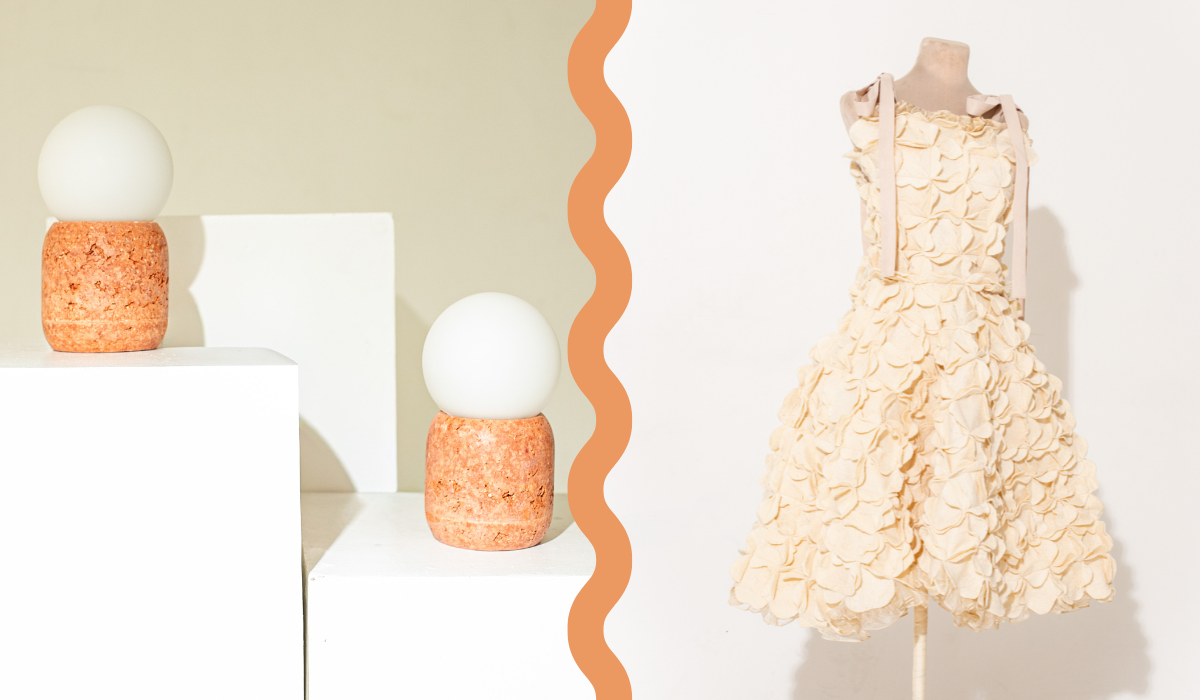
Hiblatech’s exhibit showcased a curated constellation of collaborators: Chini Lichangco, Jasser Aguila, Krete Manila, Edward Sibunga, Selena Placino, Jema Gamer, Dee Javier, Marc Carcillar, Razel Mari, and Yodel Pe. Each is stellar in their own turf, coming up with reimagined creations like table lamps (Lichangco, Aguila, and Krete Manila), dresses (Gamer), room dividers (Placino), piña sound panels (Sibunga), totes (Javier), tapestries (Carcillar), art kits (Mari), and accessories (Pe).
Personal picks
While several pieces speak to the audience, others truly resonate with them. Among the objects on display, I was most drawn to poetic experiments and prototypes that felt like a dialogue. From light to fiber, there are select stories that stayed throughout my exploration.
Krete Manila’s Pouf Lamp has a meaningful material logic—making sustainability sophisticated rather than far-fetched. Reusing traditional molds with a minor twist to it is brilliant thinking.
Jema Gamer’s Orkilap Dress, on the other hand, is an ode to fluid fashion. Its petal-shaped precision and cloud-toned character elevated the fiber, exuding couture charm and culture.

Edward Sibunga’s Piña Sound Panel surprised me to the core. The material is supposed to lighten the sound, serving as a dampener and now-driver. It absorbs noise and also emits it, perfectly embodying Hiblatech’s technology thesis: changing the base changes the behavior.
A material future in the making
Hiblatech’s origin wasn’t only a blueprint of material breakthrough. It was progress—between pineapple farmers seeking a fatter income, textile innovators with decades of expertise, and designers steering toward sustainability. The vision has always remained: add value locally rather than export raw anonymity. Reform, expand, and translate raw leaves into ideas, inspiration, and endeavors—while giving the environment a chance.
Check out Hiblatech on Instagram.
Related story: Project Pan: The beauty anti-trend that drives conscious consumption
Related story: Slow food movement is about ‘regeneration—not just sustainability’