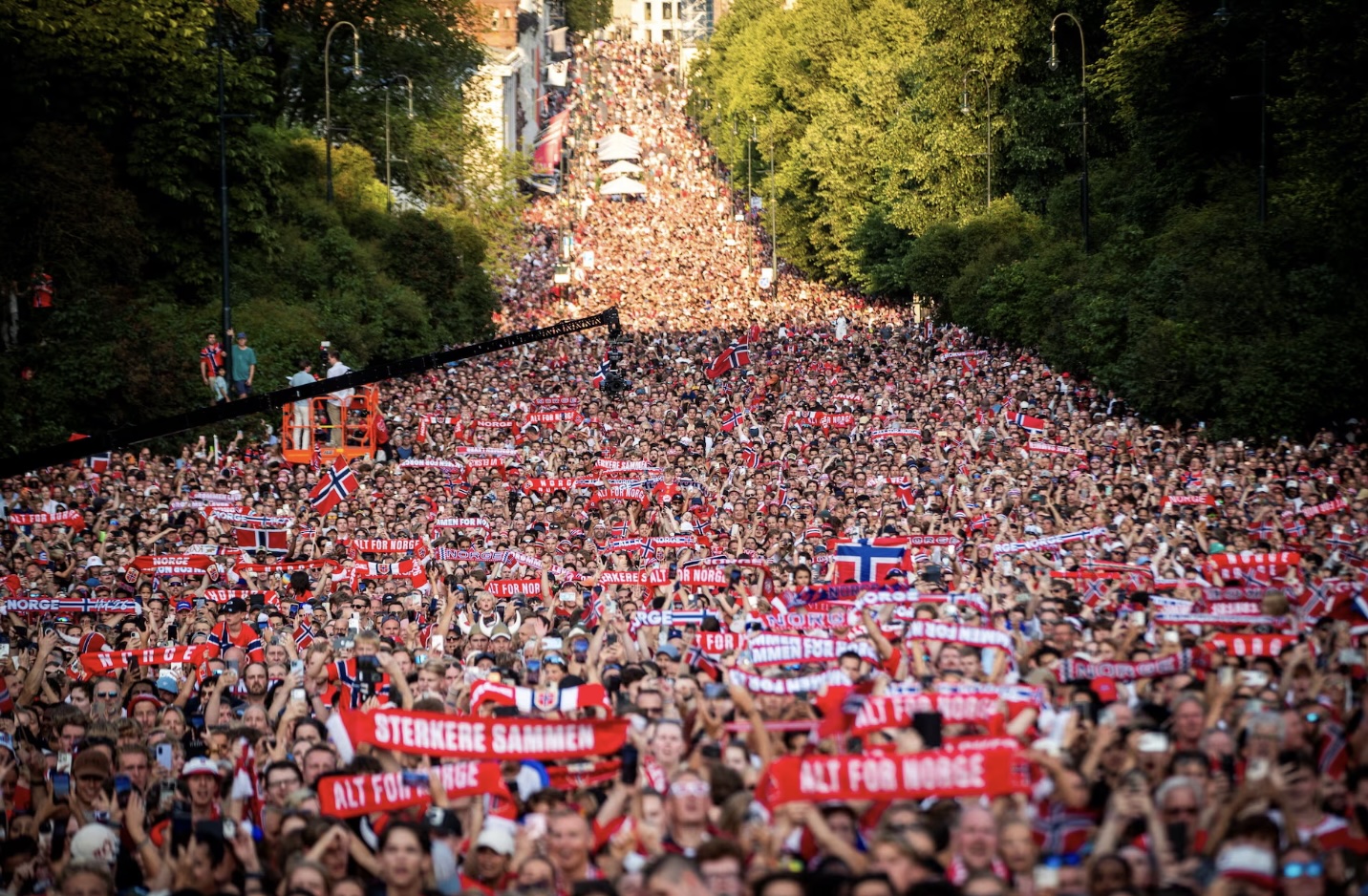

More than 100,000 people turned up in Oslo’s Palace Square to celebrate and do the Viking Row, giving us the World Cup’s most unforgettable image.
Since the World Cup started, two things have fascinated me. The first is Scotland’s Tartan Army and how they drank Boston dry, marching in parades led by kilt-wearing, bagpipe-playing fans who couldn’t resist putting a traffic cone on every statue’s head. The second is Norway and that damn catchy tune from Erling Haaland’s professional team Man City (Haaland, Haaland, he’s a blue, just like his dad, now he’s at the Etihad. Ha—Ha—Ha—Haaland, Haaland).
Norway was knocked out by England in the quarter finals (2-1) but won one of FIFA World Cup 2026’s most powerful moments. Led by striker and shampoo-commercial-worthy Haaland, the team arrived in Oslo to a hero’s welcome. Their charter flight touched down at Oslo’s Gardermoen airport at 7 pm on July 13 where it was met with a traditional water-cannon salute. From the airport, the squad traveled to central Oslo for an audience with King Harald at the Royal Palace before greeting the crowd gathered at Palace Square.

Beneath Oslo’s skies on a clear, warm summer evening, more than 100,000 fans—wearing shirts with the Scandinavian cross and waving the Norwegian flag—sat down to row as Crown Prince Haakon beat the drums. It was almost an eerie scene with the silence of a thriller film between the “Ro!” chants, and the exuberant joy of The Mighty Ducks’ ending.
Then everyone stood up and cheered as if Haaland and the boys came home with the World Cup instead of being emptyhanded. No attacking a player perceived to have lost the game (Colombia, 1994), no abuse (South Korea, 2018, eggs thrown at the returning team), no threats (England,1998, at David Beckham).
Fans said the loss was devastating at first, but it quickly turned uplifting when they went outside and saw the overwhelming sense of pride of their countrymen.
If Norway had actually won the World Cup, Norwegians might have signed away the country’s sovereign wealth fund in euphoria.
Related story: Game, set, match! Five unforgettable moments at Wimbledon 2026
Related story: Before the first whistle: The chants, jerseys, and storylines defining FIFA World Cup 2026
The side stories and underdogs
I am what you would call a garden-variety World Cup follower. I have no lifelong allegiance to any team. Instead, I find myself rooting for the tournament’s best side stories.
I was in France for a post-birthday vacation in 2018 when France won (allez les bleus!). I was in Paris during the semis when the city exploded in celebration, with hundreds of thousands of fans filling the Champs Elysées and jets flying the French colors. And in Tournus, when they won the World Cup, where everyone came out and literally beat pans and made noise. For a non-football fan, the exuberance rubbed off as if it were New Year’s Eve and I was in the most beautiful city in the world. But it wasn’t, I wasn’t. I was in a small town in Burgundy and the celebration by the river was so joyous it made me want to be French.
Which brings us to the year 1998. It was the first time France won the World Cup, 20 years before 2018. It was also the last year that Norway and Scotland qualified for the World Cup before 2026, ending a 28-year drought for both.
Crown Prince Haakon of Norway beats the drum as the Norwegian people and the national team row together. pic.twitter.com/OFxL4x8Nhv
— Joakim 🌹🇳🇴🇪🇺 (@joakial_) July 13, 2026

There are other stories in this year’s matches that I love, mostly of people’s irreverence and camaraderie. I love that England fans sing Oasis’ “Wonderwall” after every win; that only three players so far have scored a hat trick with Lionel Messi being the first on June 16 (and that I learned what a hat trick in football is); that the United States lost to Belgium after Trump intervened to overturn a red card and that the Belgians mocked him relentlessly; that Norway beat Brazil (2-1), possibly sending bettors to the ER; that Estadio Azteca with its surreal vibe and elevation is called “the Mexican cathedral of football,” and that a duck waddling through the streets became Mexico’s unofficial mascot.
People, pets, traditions, victories and defeats, small nations and big spirits—the improbability of it all. That’s why it is the world’s greatest game.
As for who wins the World Cup, I’m for England—in a garden-variety, non-football fan kind of way, of course. Maybe they’ll finally shut up about football coming home.
Related story: The thrill and agony of watching EJ Obiena chase his Olympic dream
Related story: REVIEW: Netflix’s ‘Rafa’ is an intimate, inspiring look into one of tennis’ greatest champions