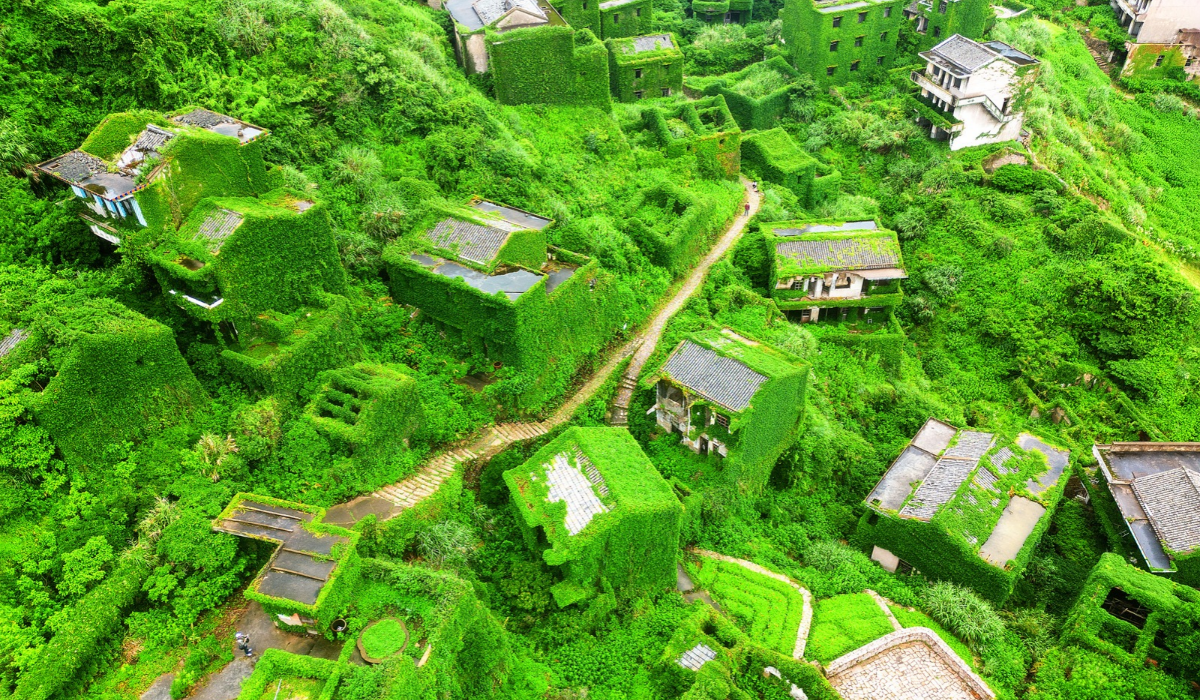

Vines veil villages, sand swallows rooms, and water submerges entire settlements in these five extraordinary places reclaimed by nature.
There’s something unsettling about seeing a place built to outlast its makers slowly surrender to something much older. A house loses its roof, a road disappears beneath greenery, a church sinks underwater, and what once looked permanent becomes part of the landscape again.
Across the globe, abandonment has left behind some extraordinary collisions between architecture and the elements. Some communities emptied after industries disappeared; others were displaced by development or disaster. What followed, however, is inevitable design: nature moved in where people moved out.
Here are five abandoned places where vines, sand, water, volcanic ash, and roots have rewritten what humans left behind:
Houtouwan, China: A village veiled in green
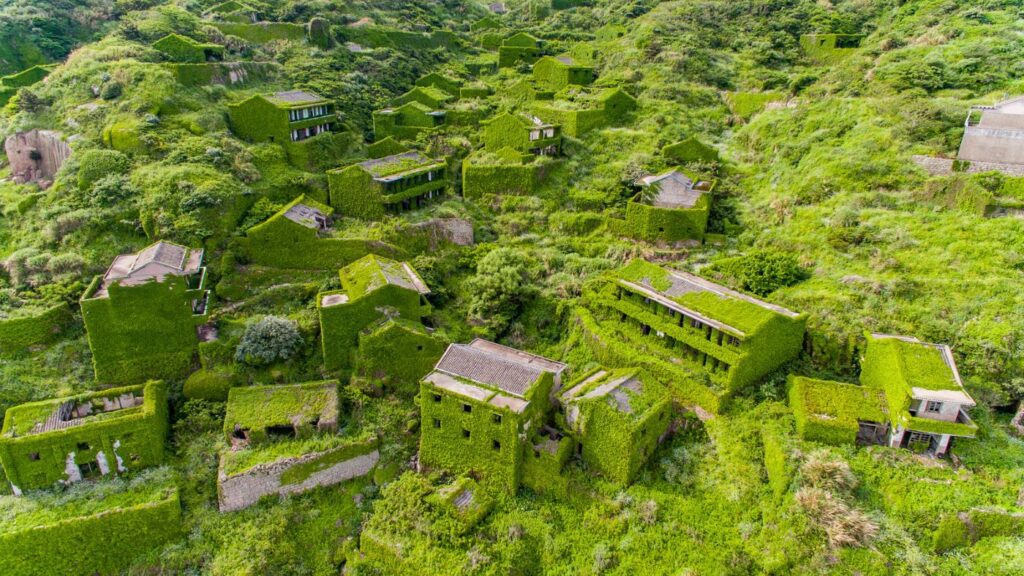
On Shengshan Island, east of Shanghai, Houtouwan looks almost too beautifully composed to be abandoned. Houses climb a hillside facing the sea, but their stone façades, windows, stairways, and roofs have steadily disappeared beneath a dense coat of creepers.
The fishing village was established in the 1950s and eventually grew to more than 2,000 residents. Its remote location and declining fishing industry, however, made life increasingly difficult, prompting most of the community to relocate. Today, only a small number of residents remain, while visitors come to see the extraordinary greenery that has engulfed the settlement.
It’s perhaps the gentlest-looking takeover on this list. There are no dramatic dunes or catastrophic ruins here—just architecture slowly softening into the hillside until the distinction between house and habitat begins to blur.
Kolmanskop, Namibia: When the desert walks through the door
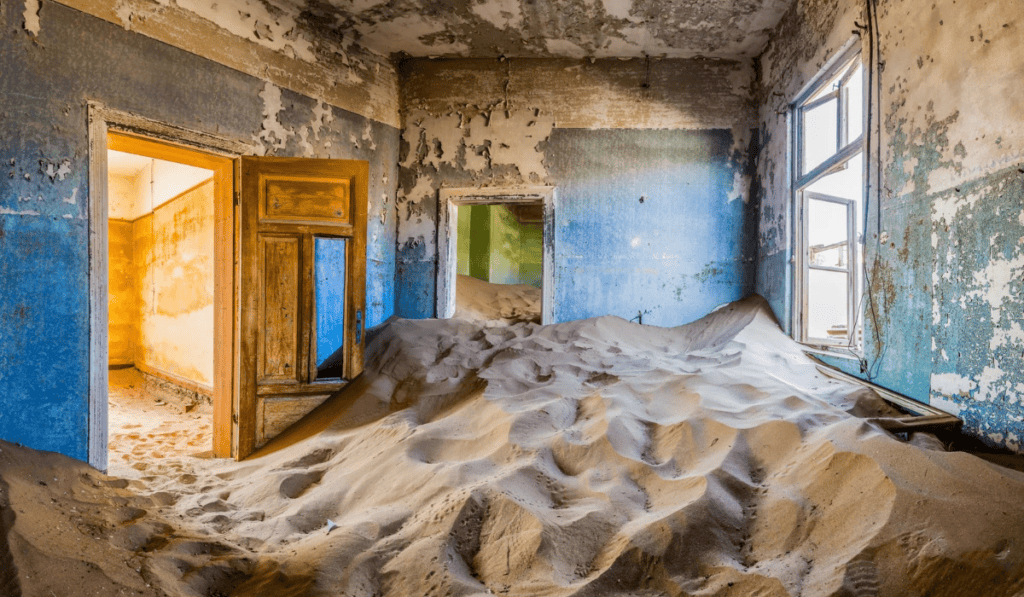
If Houtouwan was swallowed by green, Kolmanskop was consumed in gold. The Namibian ghost town owes its existence to diamonds. After one was discovered in the area in 1908, Kolmanskop developed into a prosperous mining settlement, complete with grand houses, a hospital, and a theater. As deposits dwindled and mining activity shifted elsewhere, so did its population. By 1956, the town had been abandoned. The desert has been redecorating ever since.
Sand pours through doorways and gathers against faded walls. Entire rooms have become miniature dunes, creating the surreal sight of once-domestic spaces filled waist-high with the landscape outside. Kolmanskop remains accessible through organized ghost-town visits promoted by Namibia’s official tourism platform.
Sant Romà de Sau, Spain: A town beneath the water
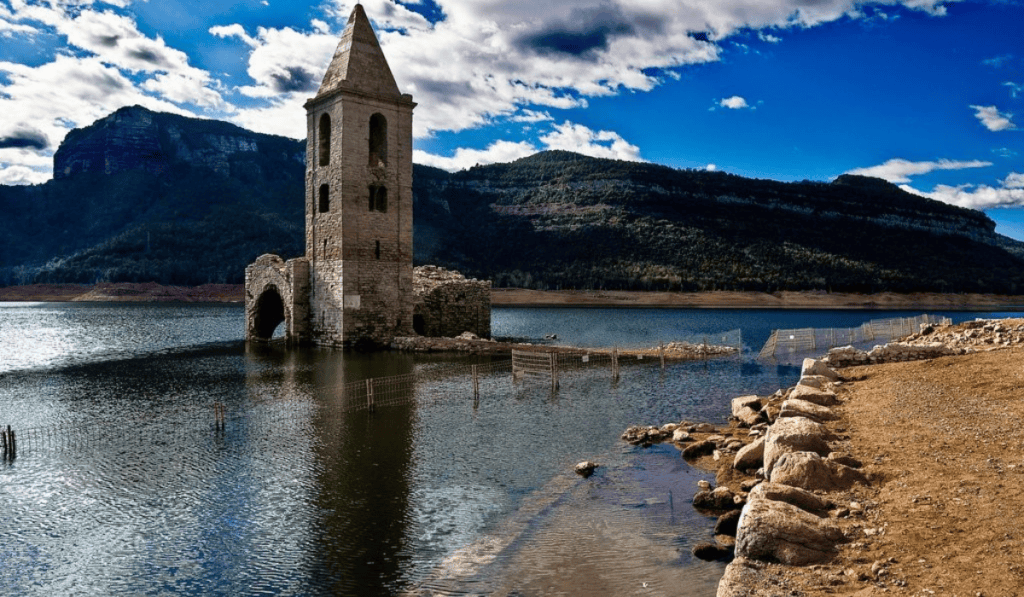
At first glance, the reservoir at Sau in Catalonia appears almost undisturbed. Then there’s the church tower.
Sant Romà de Sau was submerged following the construction of a dam on the Ter River, with much of the centuries-old settlement disappearing beneath the reservoir in the early 1960s. Its Romanesque church became the village’s most recognizable survivor, its tower rising above the water like an architectural marker for everything hidden below.
Water levels can occasionally reveal more of what remains. It makes Sant Romà de Sau particularly haunting: the town hasn’t vanished completely. Instead, it sits beneath the surface, occasionally returning to view as the landscape changes.
Plymouth, Montserrat: A capital caught beneath ash
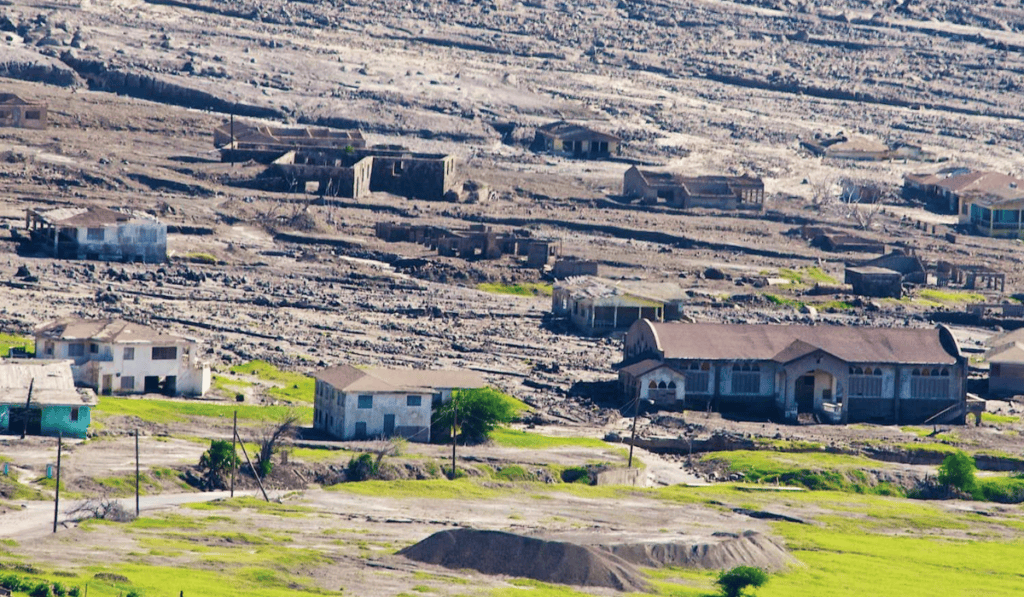
Plymouth wasn’t a forgotten settlement slowly emptied by time. It was—and officially remains—the capital of Montserrat.
Its transformation came with the Soufrière Hills Volcano, which began erupting in 1995 after centuries of dormancy. Ash, mud, and volcanic debris devastated much of southern Montserrat, including Plymouth, eventually rendering large portions of the island uninhabitable.
Today, parts of buildings still emerge from the volcanic landscape. The Montserrat Tourism Authority describes Plymouth as the only volcanic-buried town in the Americas, with remnants and abandoned belongings still visible within the deserted capital. Access is tightly controlled: Plymouth sits within the Exclusion Zone and can only be visited with a certified guide.

Nature’s reclamation here feels less romantic than raw—a reminder that landscapes don’t always retake cities gradually.
Netaji Subhash Chandra Bose Island, India: Where roots rule the ruins
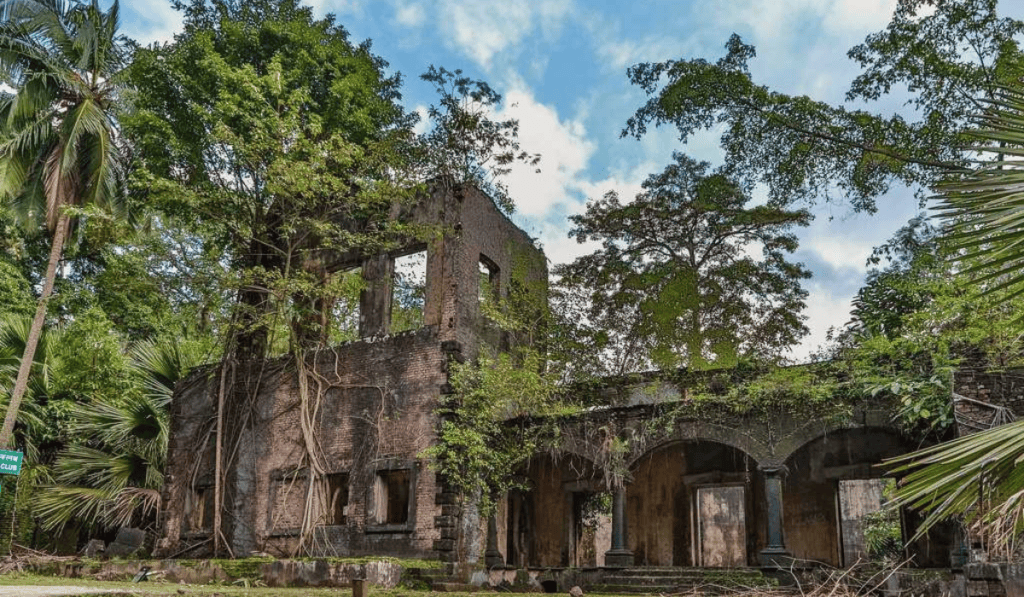
Perhaps nowhere is the contest between construction and nature more literal than on Netaji Subhash Chandra Bose Island, formerly known as Ross Island.
Located a short boat ride from Sri Vijaya Puram in India’s Andaman and Nicobar Islands, the island once served as the administrative seat of British colonial power in the territory. An earthquake in 1941 damaged the settlement, and today remnants of its colonial-era buildings survive amid thick tropical vegetation. India’s official tourism portal lists ruins including the Chief Commissioner’s House and Presbyterian Church among the structures visitors can still explore.
But, it’s the trees that have created the island’s most arresting architecture. Huge roots wrap around weathered walls and descend across old façades, seemingly holding some structures together while simultaneously pulling them apart.
Nothing here is truly frozen in time. The buildings may have been abandoned, but the landscapes surrounding them remain very much alive—growing, shifting, flooding, burying, and slowly turning human history into something wild again.
Related story: In this Italian town, residents are ‘banned’ from falling ill
Related story: Chinatowns in different countries: Gates, gastronomy, and global grandeur