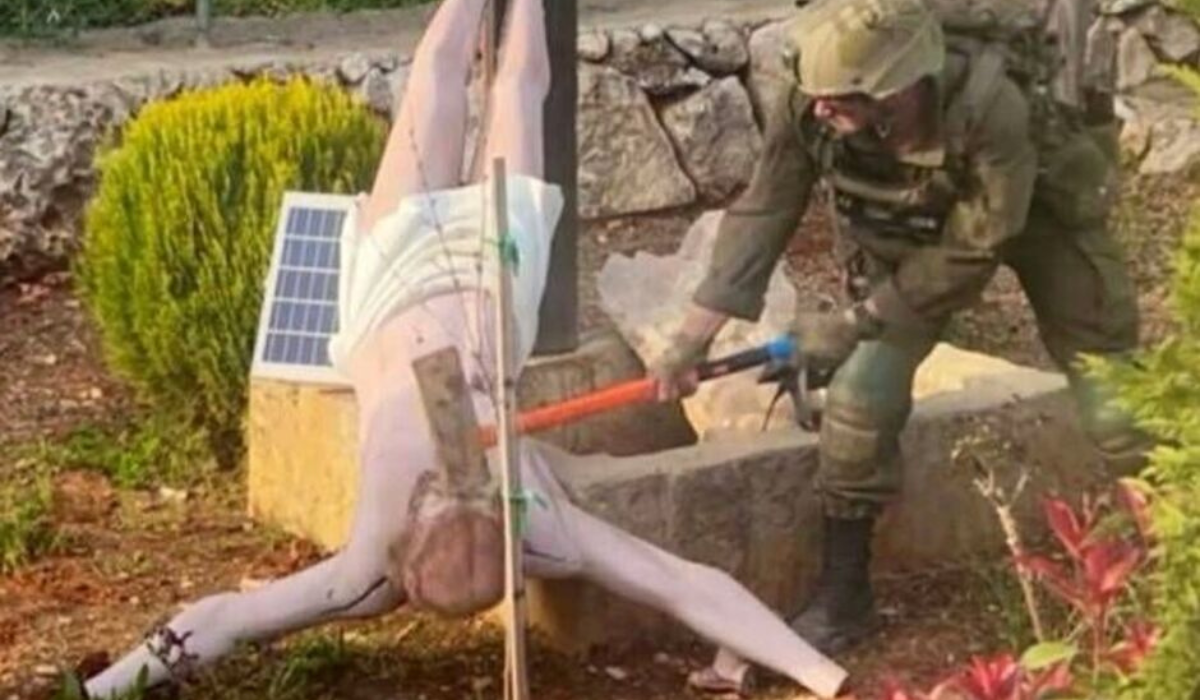

A video of a soldier sledgehammering a statue of Christ in southern Lebanon has sparked extensive outrage, prompting official responses and raising deeper questions about conflict, culture, and respect.
A short video, widely shared across social media this week, has triggered a long-standing tension in the Middle East. Footage showing an Israeli soldier striking a statue of Jesus Christ in southern Lebanon has drawn sharp reactions—from religious communities, political leaders, and global observers alike. What may appear as a singular act of vandalism has quickly evolved into a broader conversation about cultural respect, military conduct, and the fragile intersections of faith and conflict.
The incident reportedly took place in southern Lebanon, where Israeli forces have been operating amid ongoing cross-border tensions. In the video, a uniformed soldier is seen using what appears to be a sledgehammer to damage a statue depicting Jesus Christ—an image that holds deep religious significance, particularly for Christian communities in Lebanon and across the region.
The footage spread rapidly online, amplifying outrage and prompting demands for accountability. The act was widely condemned not only as destruction of property, but as a symbolic affront to religious heritage. While details around the exact timing and operational context remain limited, the visibility of the video has made the incident difficult to contain within military channels.
Israeli officials moved quickly to respond. Prime Minister Benjamin Netanyahu publicly condemned the act, calling it inconsistent with the values of the Israeli military. The Israel Defense Forces (IDF) also stated that the soldier’s actions did not reflect its code of conduct and confirmed that the incident is under review.
Such responses aim to contain diplomatic fallout, particularly as Israel navigates an already sensitive regional landscape. However, critics argue that condemnation alone may not be sufficient without transparent accountability measures.
A region shaped by religion and conflict
Lebanon is home to a diverse religious population, including a significant number of Christians for whom religious imagery carries profound cultural and historical weight. Acts perceived as disrespect toward these symbols often resonate far beyond their immediate context.
This is especially true in a region where political conflict is frequently layered with religious identity. Even isolated incidents can take on amplified meaning, feeding into broader narratives of marginalization, occupation, or cultural disregard. For many observers, the destruction of the statue is not just about damage—it’s about what that damage represents.
The power—and peril—of viral moments
What distinguishes this incident is not just what happened, but how quickly it was seen. In an era where conflict is increasingly documented in real time, visual evidence travels faster than official statements. A single clip can shape public perception before facts are fully verified or contextualized.
For militaries and governments, this creates a new layer of accountability—one where actions on the ground are instantly subject to global scrutiny. For audiences, it underscores the importance of critical consumption: understanding both the emotional weight and the geopolitical complexity behind what’s being shared.

Insight: Why this moment matters
This incident lands at a time when the Middle East remains deeply sensitive to symbolic gestures—intentional or otherwise. It highlights how cultural and religious respect is not peripheral, but central, to maintaining any form of stability in contested regions.
For a millennial audience accustomed to digital immediacy, the story also reflects a larger truth: visibility changes stakes. What might once have remained a localized issue is now part of a global conversation—one that blends politics, identity, and public accountability.
The damaged statue in southern Lebanon is more than a broken figure—it has become a focal point for broader tensions that extend beyond borders. As investigations continue and responses unfold, the incident serves as a reminder of how fragile respect can be in conflict zones, and how quickly a single act can resonate across cultures and continents.
In a region already defined by complexity, moments like these reinforce a simple but critical principle: in places where history, faith, and politics converge, even the smallest actions can carry lasting consequences.
Related story: When travel crosses the line: What recent tourist incidents in Asia reveal
Related story: How the Middle East conflict is reshaping travel across Asia