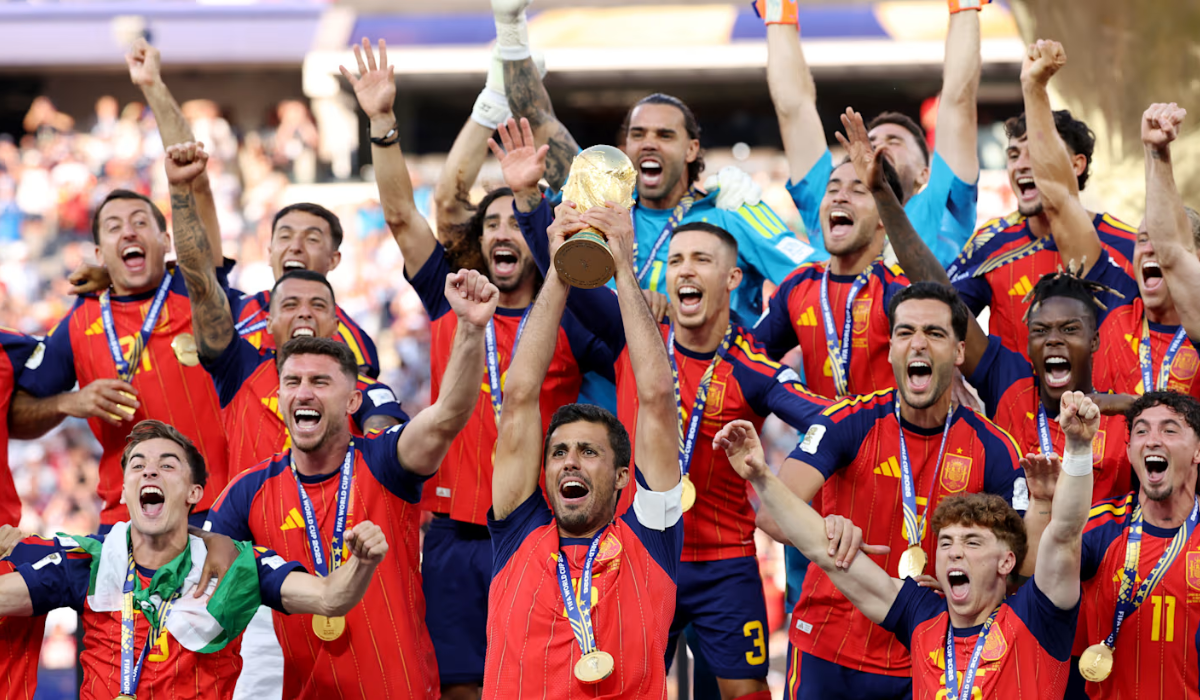

Spain arrived in North America chasing history. It left with something even more meaningful: the unmistakable feeling that football’s future has arrived.
Spain is World Cup champion once more. La Roja beat Argentina 1-0 in extra time in FIFA World Cup 2026 final on Sunday at MetLife Stadium, with substitute Ferran Torres striking in the 106th minute to deliver the nation’s second title after 2010—and, remarkably, to make Spain the first country ever to hold both the men’s and women’s World Cups simultaneously.
For 90 goalless minutes, Spain dominated the ball and the chances while Argentina, missing much of its usual attacking rhythm, leaned on a heroic Emiliano Martínez, who made a reported 11 saves—the most by any goalkeeper in World Cup final history. Argentina was reduced to 10 men in stoppage time when Enzo Fernández picked up a second yellow card, and the extra man finally told in extra time: Nico Williams’ header found Pedro Porro, whose cutback was finished by Torres for the only goal of the game.
It capped an ice-cold knockout run for Spain, who conceded just once across the entire tournament—winning against Austria, Portugal, Belgium, and France, with Mikel Merino’s stoppage-time strike against Cristiano Ronaldo’s Portugal in the round of 16 standing out as a defining moment of Ronaldo’s own World Cup farewell.
For one unforgettable month, the 2026 FIFA World Cup delivered everything the sport promised. It produced emerging superstars and emotional farewells, tactical masterclasses and dramatic upsets. By the time Ferran Torres bundled home the extra-time winner that sealed Spain’s 1-0 victory over Argentina in the final, the tournament had become more than a championship. It had become football’s changing of the guard.
Heartbreak for Messi
For Lionel Messi, it was agonizingly close to the fairytale ending: back-to-back World Cup titles, something no captain has achieved since Brazil in 1962. Instead, at 39, he watched Rodri and Spain’s midfield smother his influence for long stretches, with Argentina managing just two shots across 120 minutes and none on target.
Even in defeat, Messi leaves this tournament having rewritten the World Cup record books. Across six World Cups—a run matched only by Ronaldo—he finishes with 34 appearances, 21 goals and 12 assists, more games and more assists than anyone in the competition’s history. Undeniably, he was Argentina’s talisman throughout the tournament.
As confetti fell in East Rutherford, New Jersey, many eyes remained fixed on the other side of the pitch. Lionel Messi stood motionless before finally walking away in tears.
The image instantly joined football’s gallery of unforgettable photographs—not because Argentina had failed, but because the world knew what the moment represented. At 39, Messi had entered the Cup acknowledging that this would almost certainly be his last. He had carried Argentina back to another final, hoping to defend the title they won in Qatar four years earlier. Instead, his final appearance on football’s biggest stage ended in heartbreak.
While speculation about his retirement intensified immediately after the final, Messi stopped short of officially announcing the end of his international career, leaving supporters waiting for one final decision. Whether or not Messi ultimately wears Argentina’s shirt again almost feels secondary.
The photo that predicted it all
Long before kickoff, social media had revived a photograph from 2007 showing a then-20-year-old Messi cradling an infant during a UNICEF charity calendar shoot. That baby, of course, was Lamine Yamal. What once looked like an ordinary fundraising photo suddenly became football’s most poetic full-circle moment. Nearly two decades later, the child in Messi’s arms stood across from him in a World Cup final, representing the very generation prepared to inherit the sport. The internet couldn’t have scripted a better metaphor if it tried.
Yamal, meanwhile, never seemed burdened by the symbolism surrounding him.

Throughout the tournament, the Barcelona teenager played with a joy that contrasted beautifully against the pressure of football’s grandest occasion. He danced past defenders, celebrated with childlike delight, and approached every match as though he were still playing in the neighborhood rather than under the brightest lights in world sport. While Ferran Torres ultimately scored the winning goal, Yamal emerged as one of the tournament’s defining faces—a reminder that football’s future can be fearless as much as it is gifted.
Looking ahead to 2030
Attention now turns to the World Cup’s centenary edition. The 2030 tournament will be jointly hosted by Spain, Portugal, and Morocco—the first World Cup to span two continents, Europe and Africa—with three ceremonial centenary matches played in Uruguay, Argentina, and Paraguay to mark 100 years since the inaugural 1930 tournament in Montevideo. Spain will arrive as defending champions on home soil, while Argentina—and perhaps a 43-year-old Messi—will have four years to decide whether one more chapter is possible.
For now, though, Sunday belongs to Spain: worthy, near-flawless champions of the world, twice over.
Related story: Football fans are turning the US into the world’s biggest block party
Related story: Before the first whistle: The chants, jerseys, and storylines defining FIFA World Cup 2026