
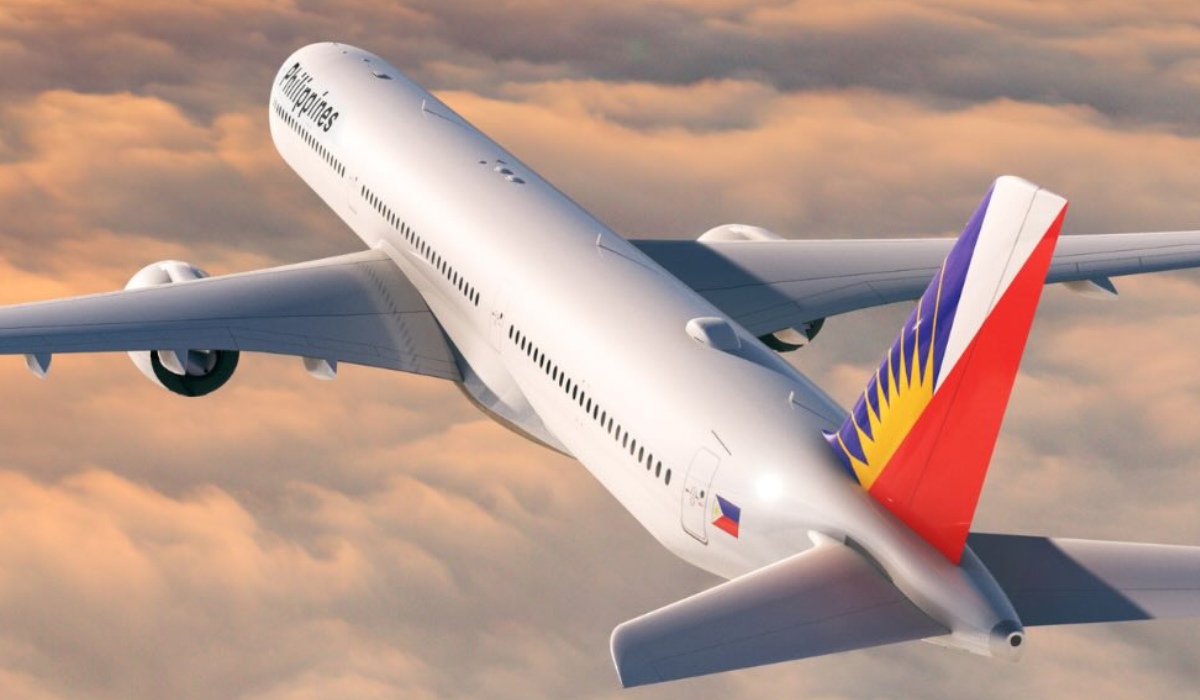

The newest arrival brings private Business Class suites, 4K entertainment, Wi-Fi, and a cabin built for some of Philippine Airlines’ longest flights.
A new giant wearing the Philippine flag in the skies has just landed.
Philippine Airlines (PAL) welcomed its fourth Airbus A350-1000 to Manila on September 2, adding another aircraft to a fleet that is becoming central to the flag carrier’s plans for long-haul travel. The plane touched down at Ninoy Aquino International Airport at 7:22 p.m. after its delivery flight from Airbus’ home base in Toulouse, France.
It may be the fourth A350-1000 to arrive, but the story behind the aircraft is much bigger. PAL is currently the first and only Southeast Asian airline operating the A350-1000, and the carrier is preparing to acquire many more.
At the Farnborough International Airshow in July 2026, PAL signed an agreement for nine additional A350-1000s, plus purchase rights for five more. Once the latest nine-aircraft deal is finalized, PAL’s total A350-1000 orders will double to 18. Plus, for travelers spending 12, 14, or even more hours in the air, what PAL has put inside the aircraft matters just as much as the machine itself.
382 passengers, three ways to fly
PAL’s A350-1000 carries 382 passengers across Business Class, Premium Economy, and Economy, with each cabin receiving a new-generation treatment. At the front is Mabuhay Studio, PAL’s new Business Class product. There are 42 suites arranged in a 1-2-1 configuration, meaning every passenger gets direct aisle access.
Each seat also measures 20.25 inches wide and converts into a fully flat bed. Sliding doors give travelers their own enclosed space, while individual vanity mirrors and several storage compartments add practical touches for an ultra-long-haul journey.
Premium Economy has 24 seats in a 2-4-2 configuration, with a 38-inch pitch, 19-inch width, seven inches of recline, integrated leg and footrests, four-way headrests, and a small cocktail table.
The largest section is Economy, with 316 seats arranged 3-4-3. Seats have a 32-inch pitch and six inches of recline, alongside four-way adjustable headrests, coat hooks, and personal-device holders. PAL’s official A350-1000 specifications list the Economy seats at 17 inches wide. That makes the final breakdown 42 Business + 24 Premium Economy + 316 Economy = 382 passengers.
The upgrades extend beyond the seat
Long-haul comfort now depends beyond legroom. Each passenger gets an embedded inflight-entertainment screen, with the A350-1000 introducing 4K entertainment and Bluetooth audio connectivity. Travelers can pair compatible wireless headphones rather than relying solely on the traditional wired connection.
Power is also spread throughout the aircraft. Business Class gets AC outlets, USB-A and USB-C ports, as well as wireless charging docks. Premium Economy passengers have AC, USB-A, and USB-C connections, while Economy seats come with both USB-A and USB-C ports.
Then there comes Wi-Fi. Business Class passengers receive complimentary connectivity, while PAL also provides complimentary internet plans to Mabuhay Miles members—including members seated in Economy—with paid access available to non-members.
The aircraft is equipped with 22 ambient mood-lighting settings, too, allowing the cabin environment to change throughout the journey. It complements Airbus’ broader Airspace cabin design, which uses high ceilings, quieter interiors, filtered cabin air, and lighting intended to make lengthy flights more comfortable. Airbus says the A350 cabin’s air is renewed with HEPA-filtered air every two to three minutes.
Built for the routes where every mile matters
The A350-1000 is no ordinary widebody. At nearly 74 meters long, it is the largest passenger variant of the A350 family and is powered by two Rolls-Royce Trent XWB-97 engines. Airbus lists a cruise speed of Mach 0.85 and a range of around 9,100 nautical miles for the latest specification of the aircraft. Its range explains why PAL is putting the jet to work across the Pacific.
The carrier has deployed the A350-1000 on key North American markets, too, including San Francisco, New York, and Toronto. PAL previously announced that San Francisco would begin receiving A350-1000 service in August 2026, while added New York and Toronto services would transition from the smaller A350-900 as more of the new flagships arrived.

With the North American push setting to grow further, PAL is launching Manila-Chicago flights in November 2026, while Airbus says the A350-1000 gives the airline the capability to develop nonstop connections between Manila and destinations on the East Coast of the United States and Canada.
Efficiency is part of the equation as well. Airbus says the A350’s new-generation engines, aerodynamics, and lightweight materials deliver around a 25% advantage in fuel burn and carbon dioxide emissions against previous-generation competitor aircraft.
PAL isn’t stopping at the A350
The A350-1000 is only one half of a much broader fleet overhaul. At Farnborough, PAL also committed to 15 Boeing 787-10 Dreamliners, with purchase rights for five more. Boeing described the agreement as PAL’s largest-ever widebody order, with the 787-10 expected to support medium- and long-haul routes. The airline giant has selected GE Aerospace GEnx-1B engines for the Dreamliner fleet, while its incoming A350-1000s will continue using Rolls-Royce Trent XWB-97 engines. Taken together, the aircraft orders lay out PAL’s fleet plans through 2036: A350-1000s taking on demanding long-haul flying and 787-10s adding capacity and efficiency elsewhere in the international network.
The expansion also comes during a remarkable stretch for the 85-year-old airline. Aviation analytics company Cirium ranked PAL the most on-time airline in Asia-Pacific for 2025, when 83.12% of its flights arrived on time. PAL had ranked eighth in the region in 2023 and seventh in 2024 before taking the top spot.
In June 2026, PAL marked another development: PAL was invited to become a member of the OneWorld Alliance. The alliance said PAL will become its 16th member airline and add 31 unique destinations to the network once its membership takes effect.
For passengers, the transformation is easier to see from the cabin: a door that closes around a Business Class suite, a bigger Premium Economy seat, a sharper screen in Economy, Wi-Fi above the Pacific, and another Philippine flag making the long journey between Manila and the other side of the world.
Related story: PAL is giving its long-haul flights a powerful upgrade
Related story: Philippine Airlines set to join Oneworld—here’s what Filipino travelers need to know