
Has the award-winning artist reached the end of his tether?
Thankfully, he hasn’t. The normally placid visual artist takes on Philippine politics, and while the ingredients are nasty, the results are, surprisingly, quite witty. But then Legaspi has always sandwiched wit in his works. Legaspi riffs on the constant, unceasing chaos that seems to blanket and choke everyday society—and his humorous take almost makes us forget the mess we are in.
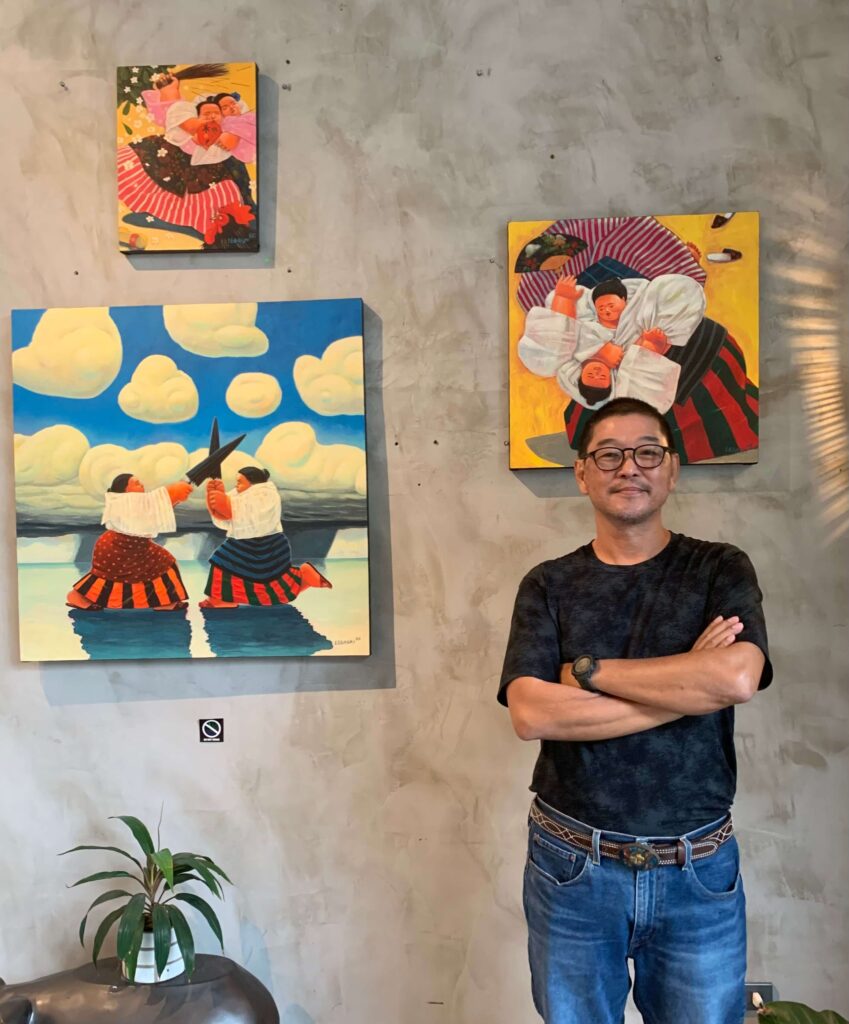
Employing the traditionally stout ladies that are his favorite avatars, Legaspi leads us through visual narratives of women warfare, whether situated in a ricefield, much better suited for cultivation than mutual destruction, or an Amorsolo-esque bucolic landscape, the better to get his point across that conflict has existed in this land even as long ago as, say, the Spanish occupation.
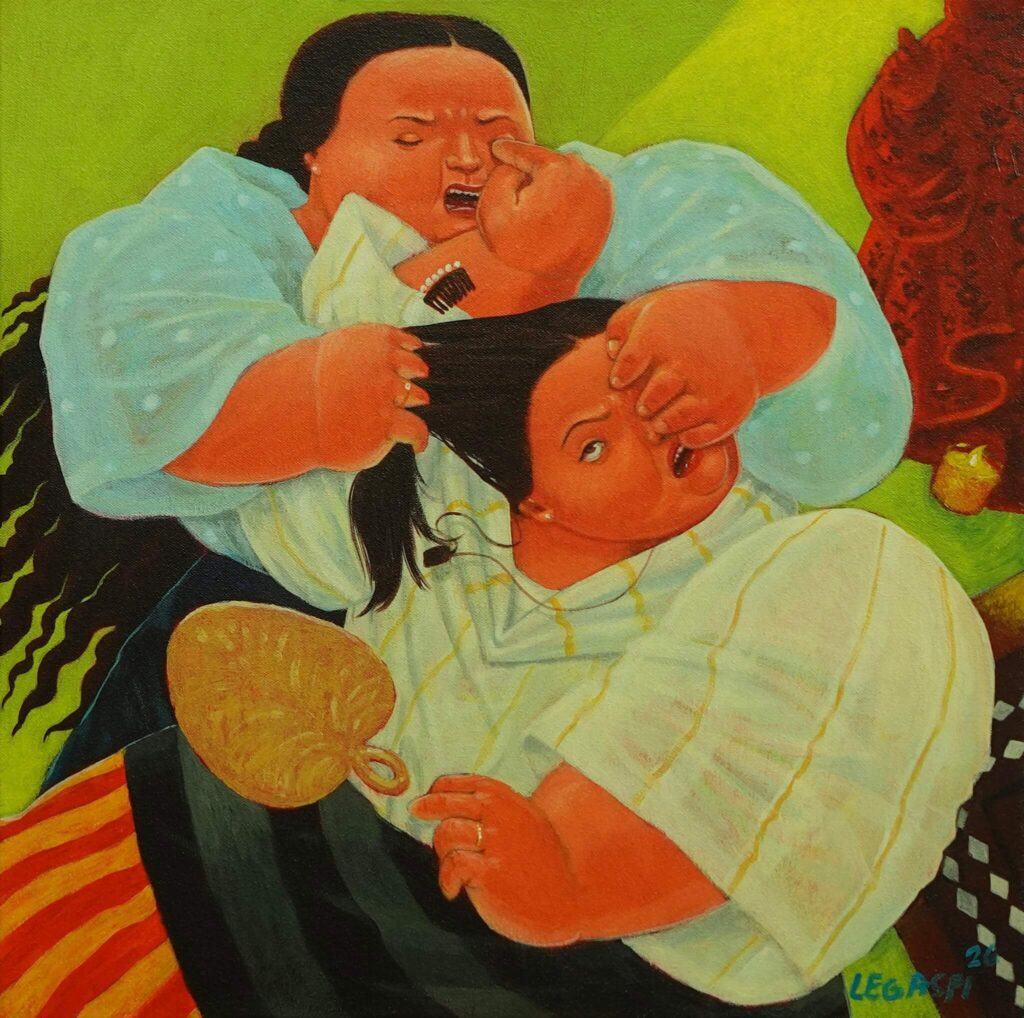
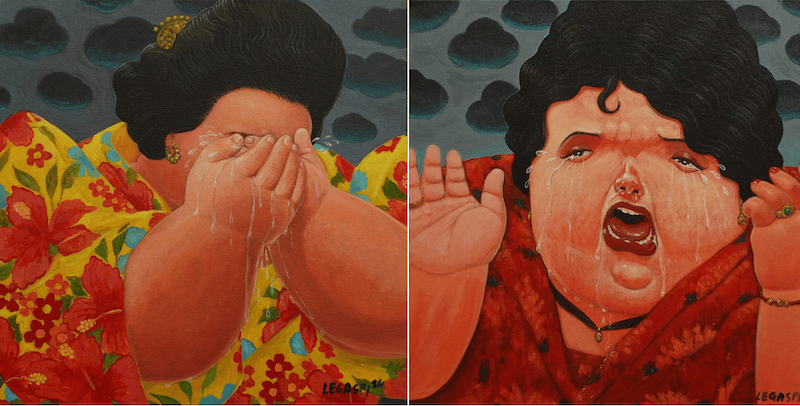
There are close-ups of rage, tears, frowns, and sundry other expressions, and we are exposed via his freely flowing, semi-rough strokes to a range of emotions, all centered on (and triggered by) these troubling times in which we find ourselves.
We might think that this visual assault is all the reference we need, except that the titles he picks for his works spray high-octane fuel to the fire. They hew closely to extremely current events—the impeachment hearings against the Vice President, the accusations that swirl around her, the crimes with which she is accused.
Then we get the reference, we get the dig, and we get Legaspi.
Related story: From hangouts to gallery walls: The art of ‘Tambay, Toma, Tropa’
Related story: Cinemalaya 2026 is over, but these three films from its darkest edition yet still haunt us
Related story: Jay-R Delleva’s pop surrealism and the quiet power of endurance
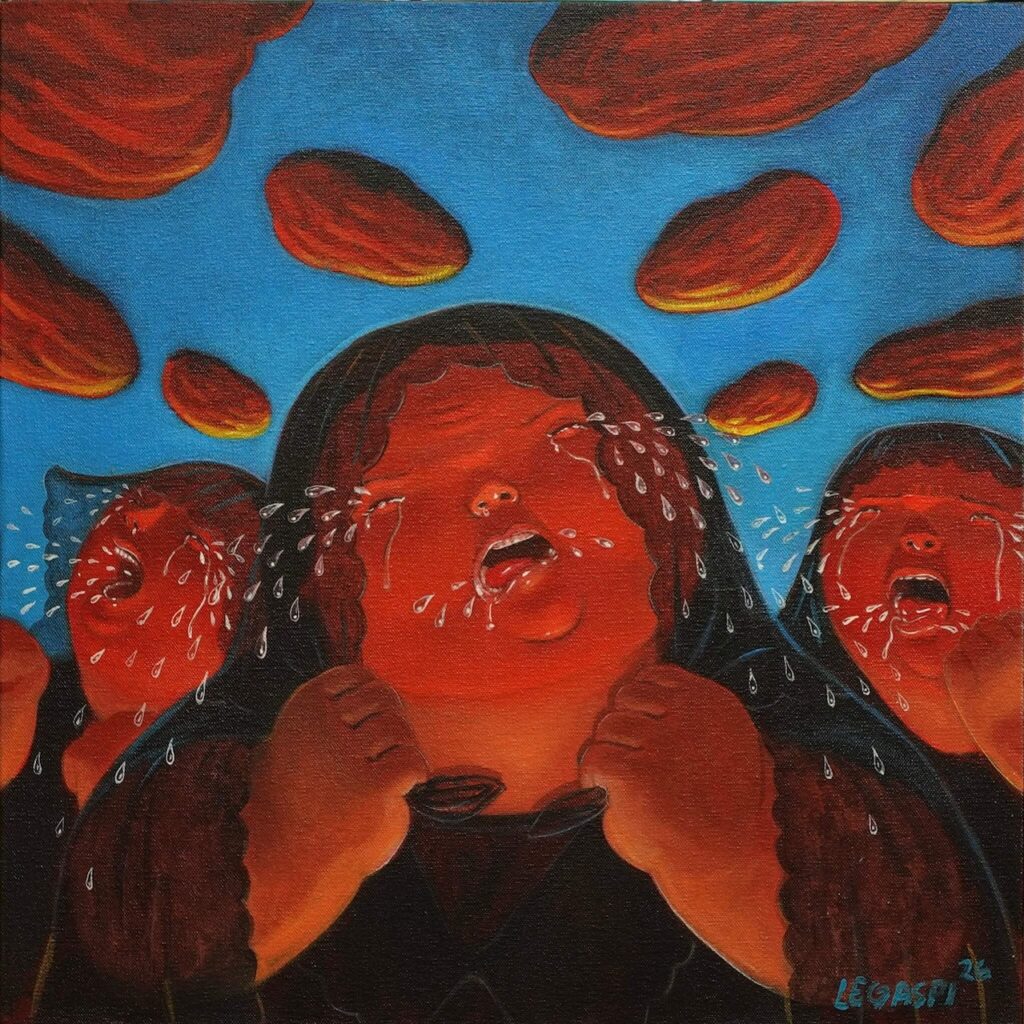
Legaspi is not merely a pretty visual artist. He might select vibrant hues for his arresting works. He might depict blue oceans and delight with elegant frocks. There might be pastoral fields and garden greens somewhere in the background. Yet, despite these calming environs, there is a deliberate layering to his pieces, thoughtful commentary that accompanies the canvases, ironic musings that filter through, and ruminations that one finds easy to resonate with.
Throughout his long and extremely successful career, especially in his native Negros Island, Legaspi has seen fit to interject meaning, substance, current events, critiques of society, and religious archetypes reflecting his Catholic upbringing, all blended and tossed cheekily into the dialogue.
We get it. We respond. We laugh. We cry.
It has been quite the journey, and moments from his sojourn are captured and preserved both as a memorial and a catalyst for future reflection. And perhaps, even action?
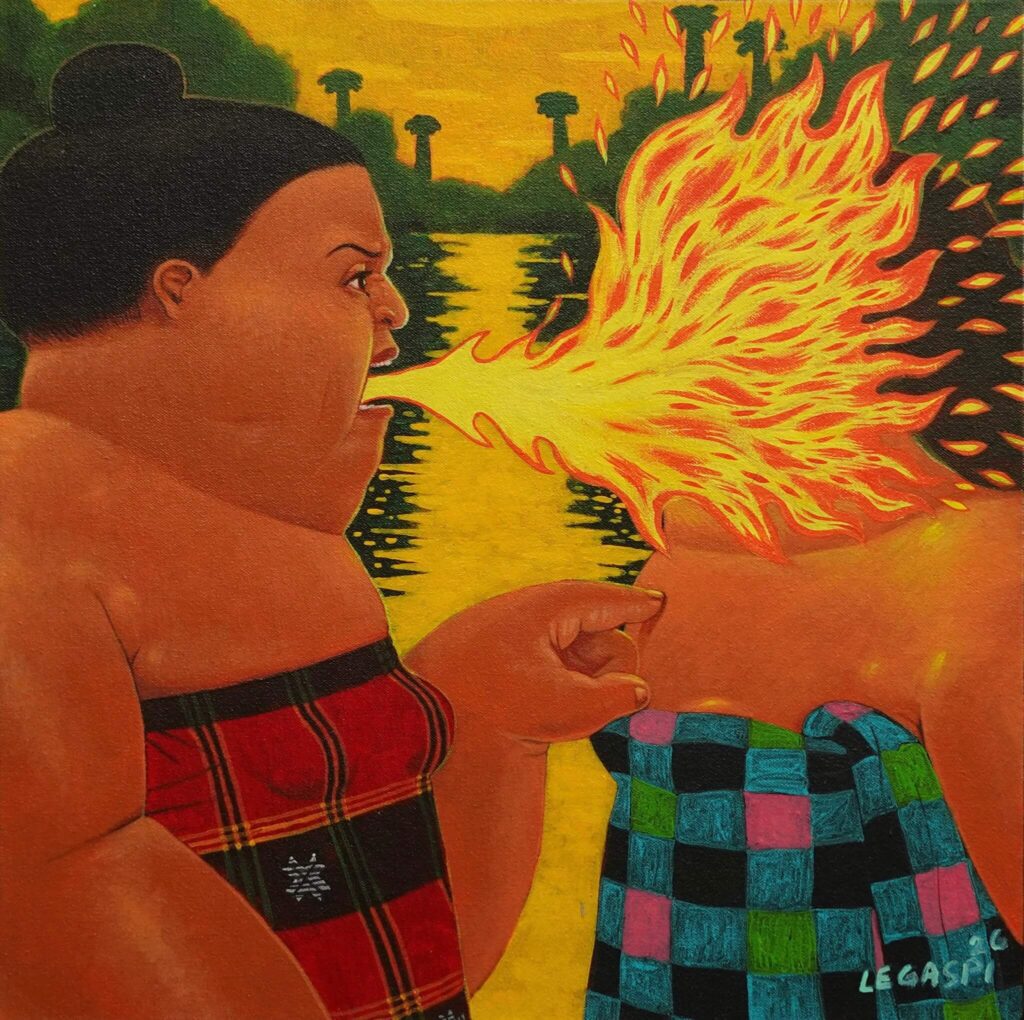
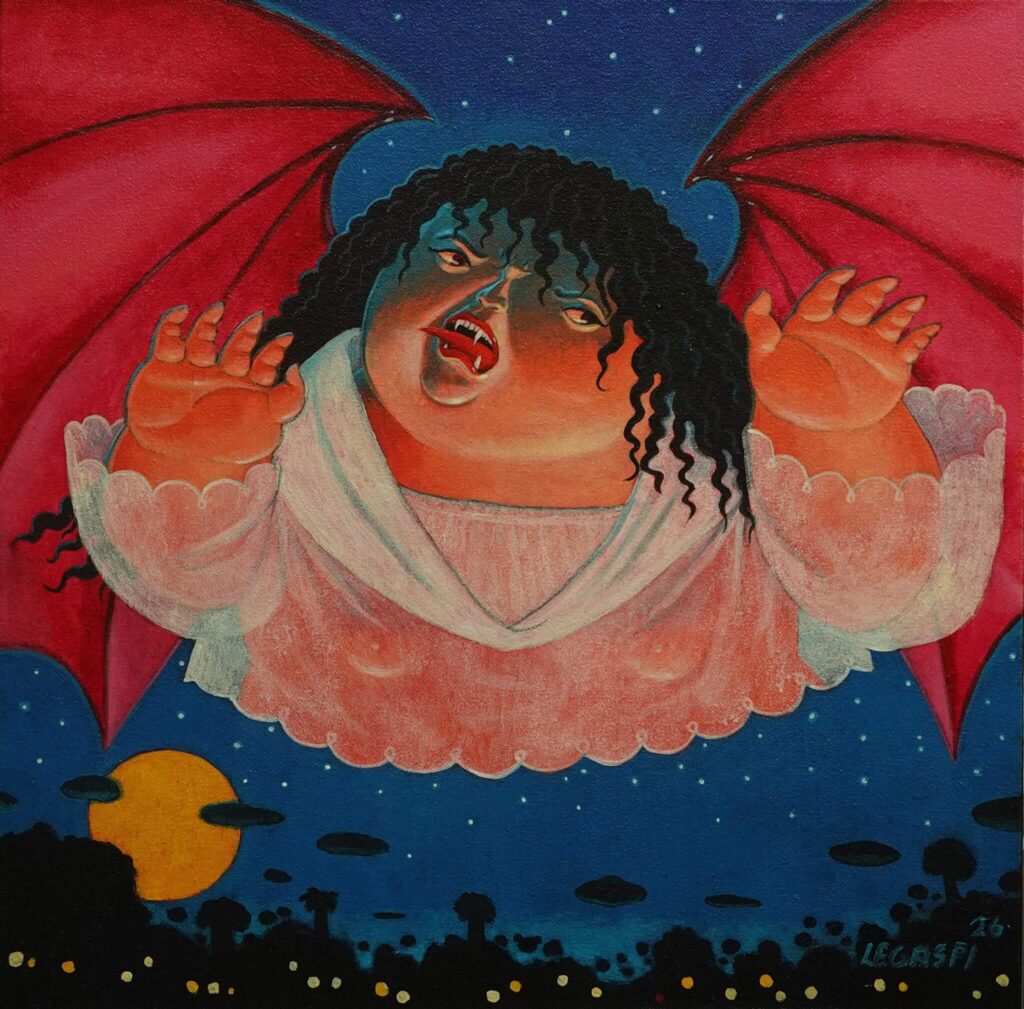
One recent example: galvanized by the prosecution of the media sensation Carlos Celdran, Legaspi whipped out a testament to that flashpoint, painting a rotund Celdran holding his divisive placard aloft in protest against the Roman Catholic Church. At that time, the public was divided: the fervent rejoiced when Celdran was criminally charged for disrupting a mass, while the free speech advocates were outraged. The subsequent death of Celdran, however, brought many to a much more mature view of the whole shebang. Legaspi was right to think that that precarious moment needed memorialization, a reminder of the cliff where society suddenly found itself.
Fast forward a few years, and social media has become ubiquitous. Legaspi (and the rest of us mortals) is inundated by bad news and scandals. The floods are relentless. Corruption is entrenched (again). The merger between two political dynasties has been torn asunder, and we now see Vice President Duterte charged before the Senate in all its impeachment court glory. Legaspi has one overarching thought—it’s non-stop trouble with a capital T.
Cue Legaspi’s collection of nearly two dozen social commentary artworks masquerading as whimsical paintings: a critique of society at large and of politicians in particular.
We see women in hand-to-hand combat, titled “At the Proper Venue.” Of course, there is no proper place for undignified combat by our female officials, and yet, there they mysteriously are, defying dignity and convention, squabbling, haranguing, and pontificating. That’s if they are not whining or crying crocodile tears.
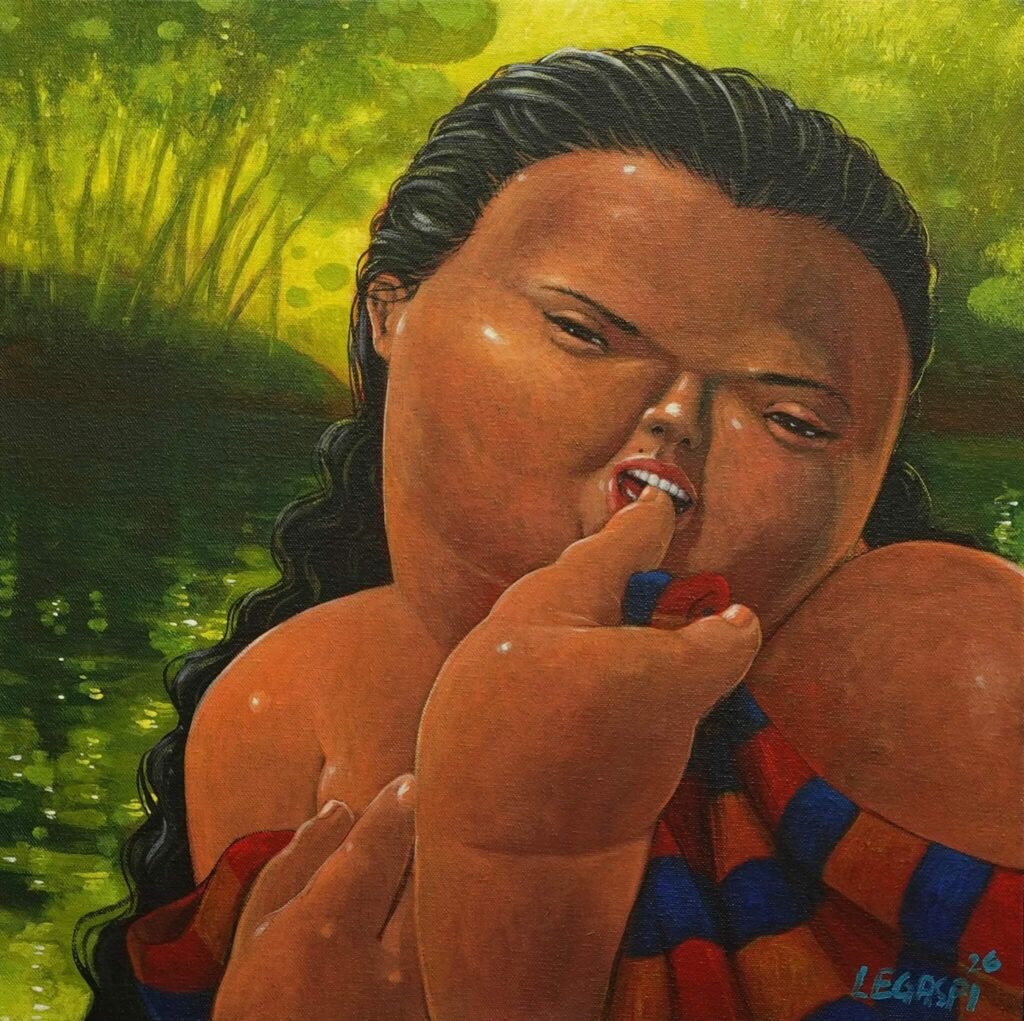
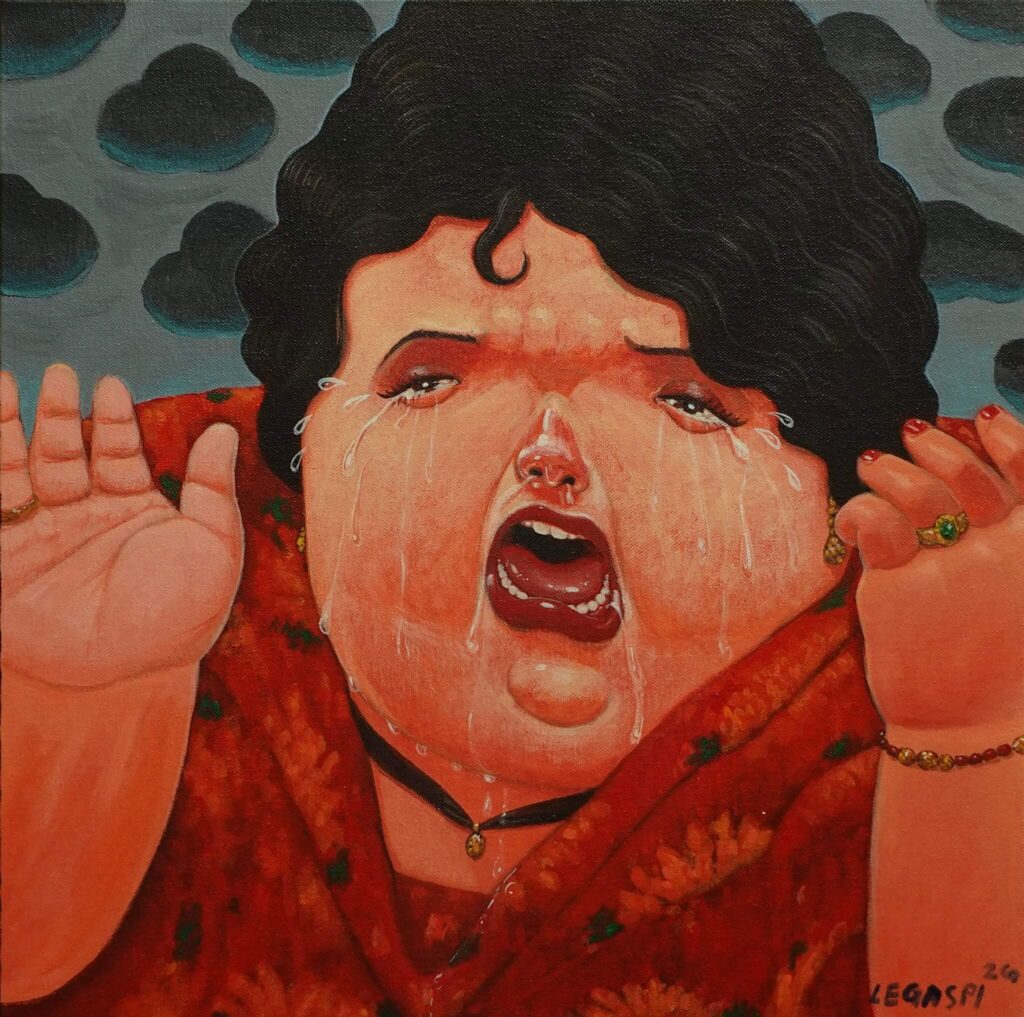
We watch as hostile witnesses are paraded by the prosecution, and Legaspi portrays “The Witness” as a blood-sucking flying vampire. We are treated to a tale that would be improbable in more civilized times, of how the second-highest official voiced out murderous thoughts at early dawn. Legaspi gives us “Grave Threats,” a blaze of fire spewing from the mouth of his doña. Crying ladies, there are plenty.

These and more nuggets form the thesis of “Always Trouble.” It is an indictment of our society and a grim reminder that we will all go down in the proverbial flames if we are held hostage by those who wish us only trouble.
A former award-winning ad executive in Makati, with his creative juices tapped by international agencies such as Ogilvy & Mather and J. Walter Thompson, Legaspi decided early on that he had had quite enough of the busy capital. He chucked his ad agency career and retreated to Silay City in Negros, there to focus on his real calling—painting.
Legaspi has received critical acclaim as well as enjoyed commercial success for his artistic expedition. After garnering the Juror’s Choice accolade at the Philippine Art Awards, Legaspi regularly exhibited in Manila’s prestigious galleries and venues (Finale Art File, Ricco Renzo, Orange Project, Canvas, Qube, Alliance Française de Manille, and the Ayala Museum, to name a few).
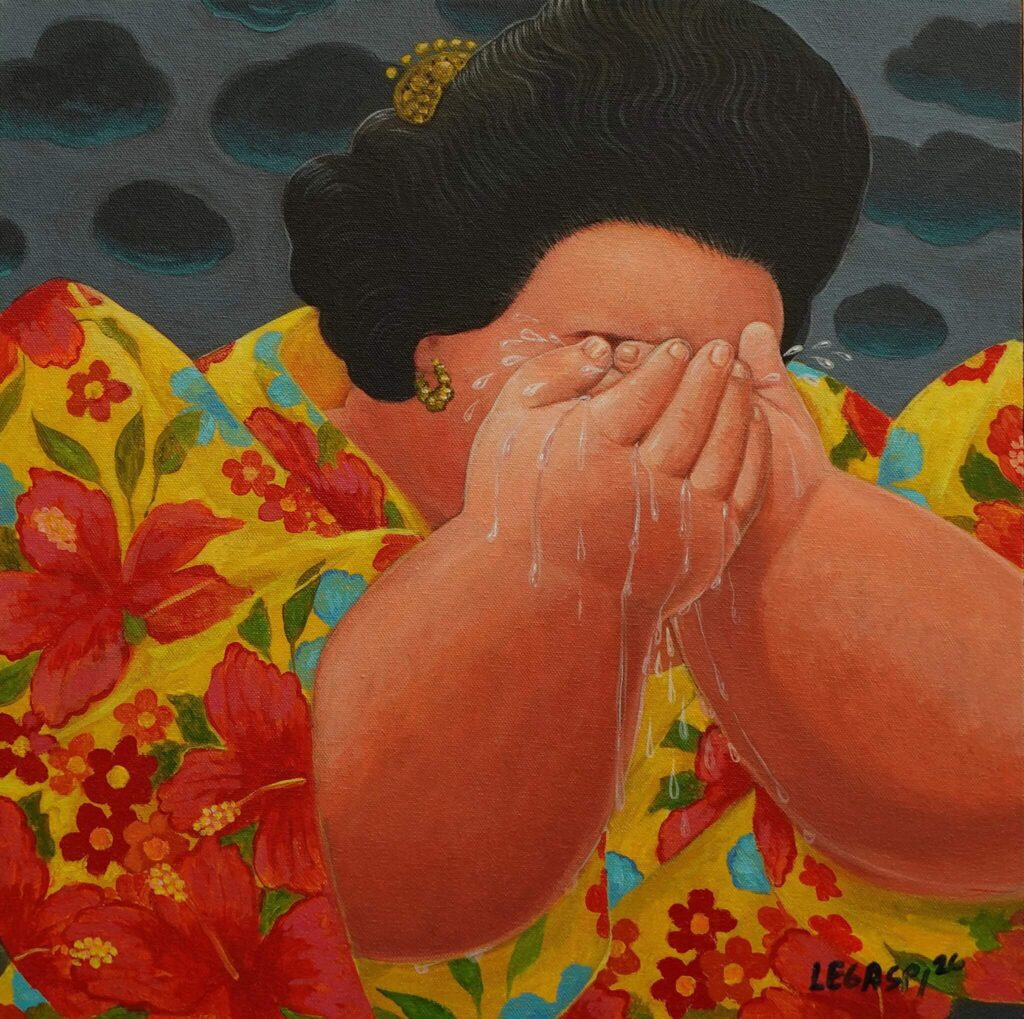
Named one of the ten most exciting artists in 2009 by the Philippine Daily Inquirer and the now-moribund Nokia, that excitement might seem muted given that Legaspi does not occupy much space in the social media arena. But he has been kept extremely busy by non-stop requests for commissioned work by the gentlefolk in Bacolod, with the landed families all clamoring for portraits done in his recognizable chubby-cheeked signature style. This is a trade-off: Legaspi’s visibility in the capital leaves much to be desired, especially for his longtime fans.
Scrolling through his Instagram account (@silaynonartist), only opened in 2020 at the height of the pandemic, the selected works from his pre-pandemic era are sufficient to induce tears of joy in any art lover. Harlequin cloaks, zebra tiles, crimson vintage cars, beloved childhood toys—it is a veritable feast of vibrant colors.
Stepping back from the metropolis and slowing down has given Legaspi time to view socio-political events with a dispassionate, and perhaps rueful, perspective. News bites, gossip, and viral moments go wafting down from the capital and are received after traversing the distance. Perhaps it is maturity. Perhaps it is wisdom. Then again, it might be dilution. But they are received with discernment, and then reflected back via Legaspi’s carefully composed encapsulations.
The news from the capital is always trouble. But Legaspi’s wry treatment reminds us it doesn’t have to be.
“Always Trouble” is on view at independent art space gallery. sort of., located at 37 Camaro St., Fairview Park, Quezon City.
Related story: A dozen queer artists take over Gallery.Sort.Of’s annual Pride exhibition
Related story: Inside the renovated PICC: A Filipino architectural landmark restored for the ASEAN Summit