
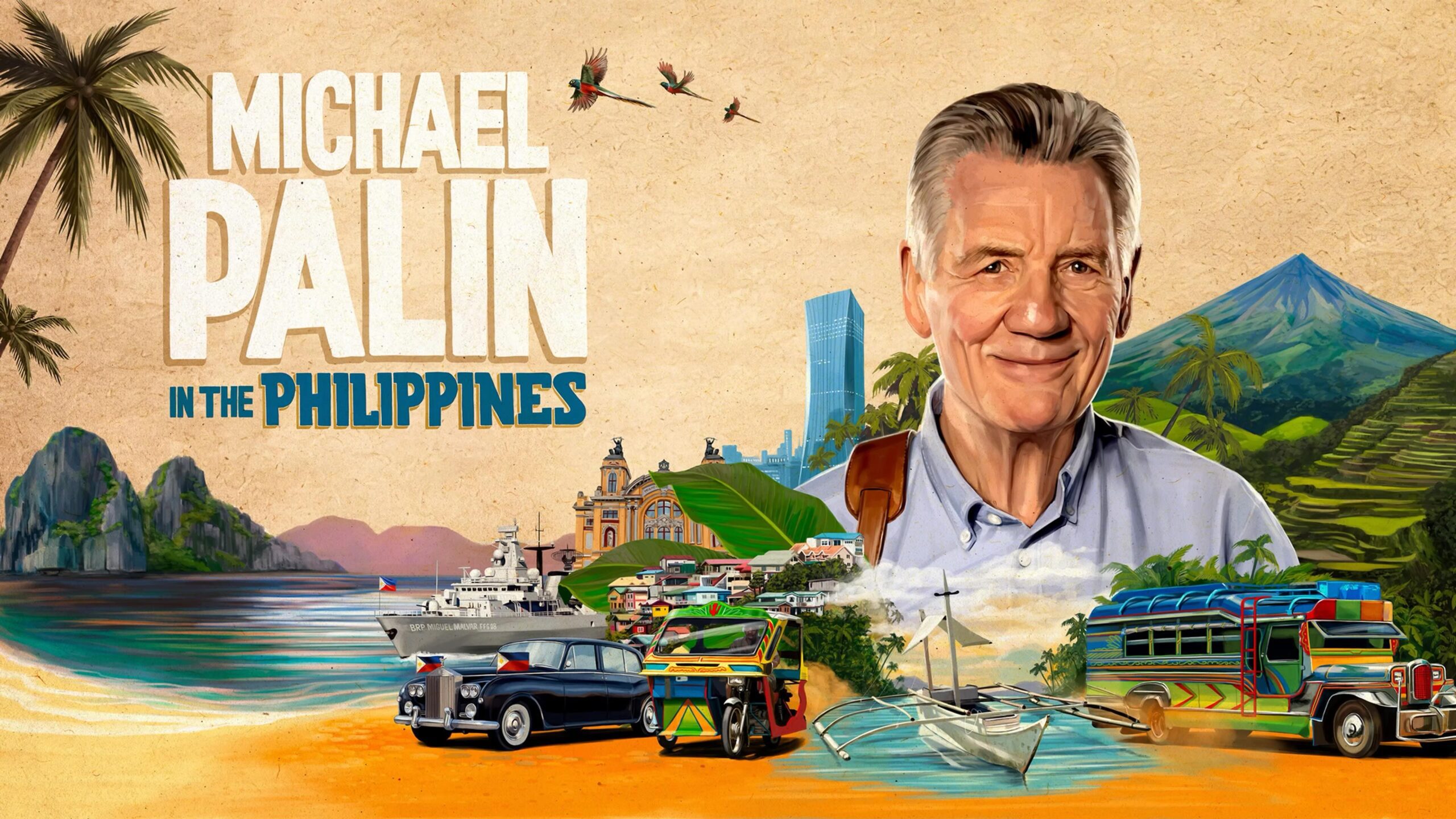
Michael Palin doesn’t just show us the Philippines—he listens to it, and that makes all the difference.
I grew up on travel shows and documentaries. From National Geographic programs to Lonely Planet (even after it became Globe Trekker), I was hooked on shows that reveal both the world’s best and worst. That is also why I begged my parents to subscribe to cable TV back in high school.
These programs also introduced me to a slew of amazing presenters. Among my favorites were Ian Wright and Justine Shapiro of Lonely Planet/Globe Trekker; Anthony Bourdain whom I first encountered in A Cook’s Tour; and the BBC’s icons: Dame Joanna Lumley (I aspire to be as fabulous as she is when I grow old), Sir David Attenborough, and, yes, Sir Michael Palin.
Now 83, the gentle, likable Palin remains one of television’s most compelling travelers. So when I heard his next show was about the Philippines, I knew I had to watch it right away. But to see why this trip matters, it helps to know how he got here.
A lifetime on the road
For those who know him only as one of the funny guys from former British comedy troupe Monty Python (or who missed the Python years entirely, like me, born in the ’80s), here’s a quick lookback. Palin’s second career began in the shadow of his first. After starring in Monty Python’s Flying Circus from 1969 to 1974, he pivoted to BBC travel programs, starting with Around the World in 80 Days in 1989. Over the next two decades, we saw the world through his eyes in Pole to Pole, Full Circle, Sahara, Himalaya, New Europe, and Brazil, making him a gold standard for travel presenters.
The Oxford alum’s recent chapter has been with Channel 5 and ITN Productions, where he has taken on destinations often deemed dangerous: North Korea in 2018, Iraq in 2022, Nigeria in 2024, and Venezuela in 2025.
Related story: The Philippines has the world’s attention. Why it matters and what it takes to keep it
Related story: Law and love: Why Philippine animal welfare needs both
The Philippines is his latest entry, though not his first visit. He came in 1997 for Full Circle, and that leg included a ferry ride across the Sulu Sea and his failure to see the famed Banaue Rice Terraces because of heavy fog.
While the Philippines is perhaps the least challenging of his recent destinations, that doesn’t mean he had it easy during his three-week sojourn in the archipelago. He arrived while our country teeters on the edge geopolitically, politically, environmentally, socially, and economically. The first frame says it all.
Episode 1: Brutal politics—and geopolitics
Instead of opening the pilot episode with generic drone shots of El Nido’s Bacuit Archipelago, the crown jewel of Philippine tourism, with its dramatic limestone cliffs and turquoise waters, Palin begins his journey with something unexpected: a rally.
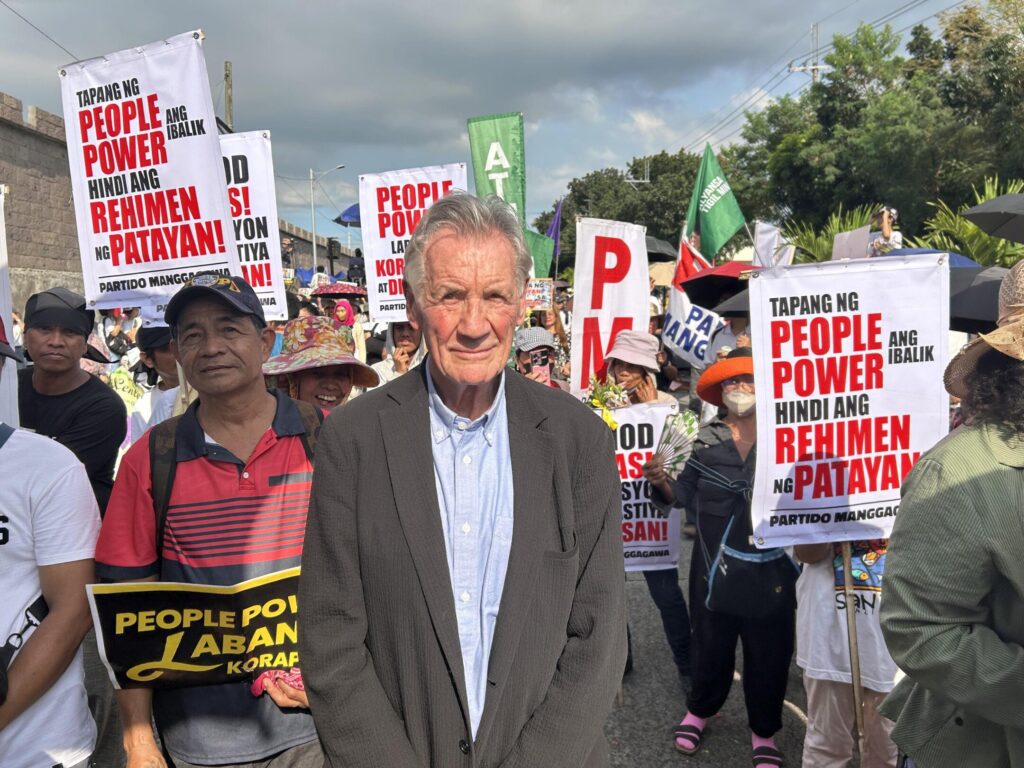
The first frame shows the octogenarian right in the middle of a rally commemorating the 40th anniversary of the People Power Revolution on EDSA, before the episode moves to a commemorative concert at the nearby People Power Monument, where he meets singer and activist Leah Navarro, whom he interviews after the program.
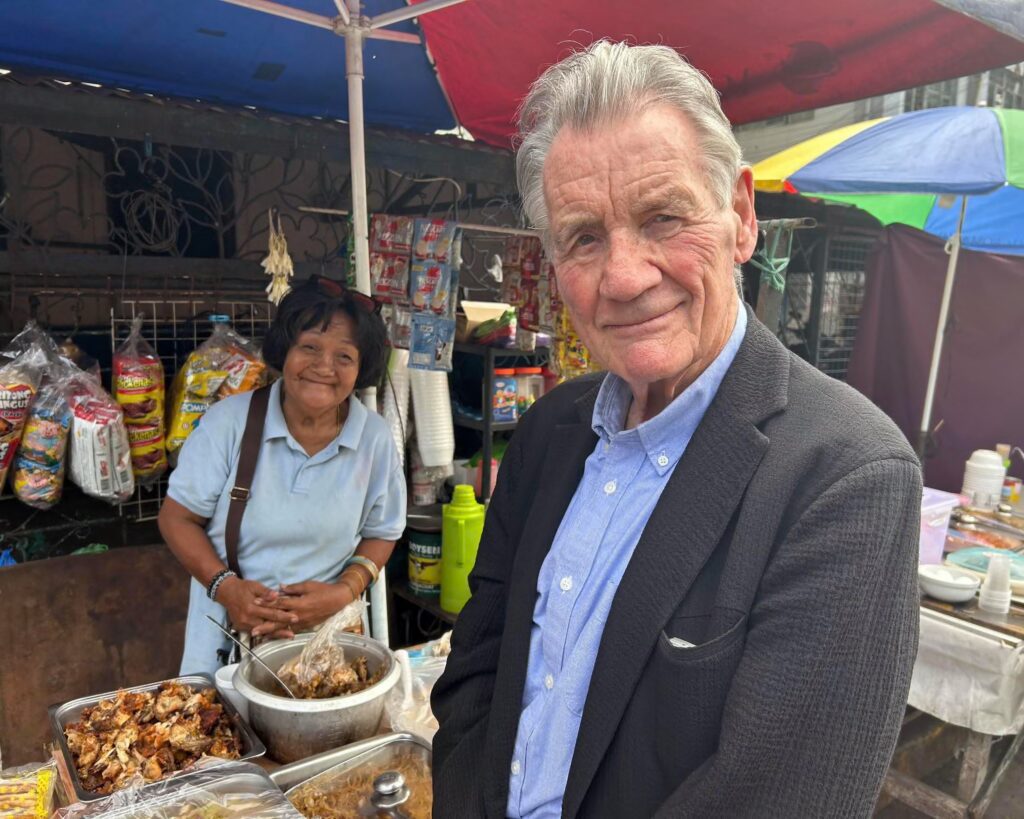
In a Tondo slum area, he is introduced to pagpag—recycled and “recooked” fast-food chicken scavenged from trash bins—a symbol of the hardship facing Manila’s urban poor. There, he meets Emily Soriano, the mother of a young victim of former President Rodrigo Duterte’s bloody drug war, an anti-crime campaign whose perpetrator is now subject to an International Criminal Court investigation into crimes against humanity.
Politics, Palin says, is a “brutal business” here, so he was rather surprised to get a call from President Ferdinand “Bongbong” Marcos Jr. himself, inviting him to Malacañang Palace. On the morning of the interview, Palin makes sure to mention that Marcos Jr. is “notorious for avoiding challenging interviews” and that they won’t be discussing “controversial political or family issues.”
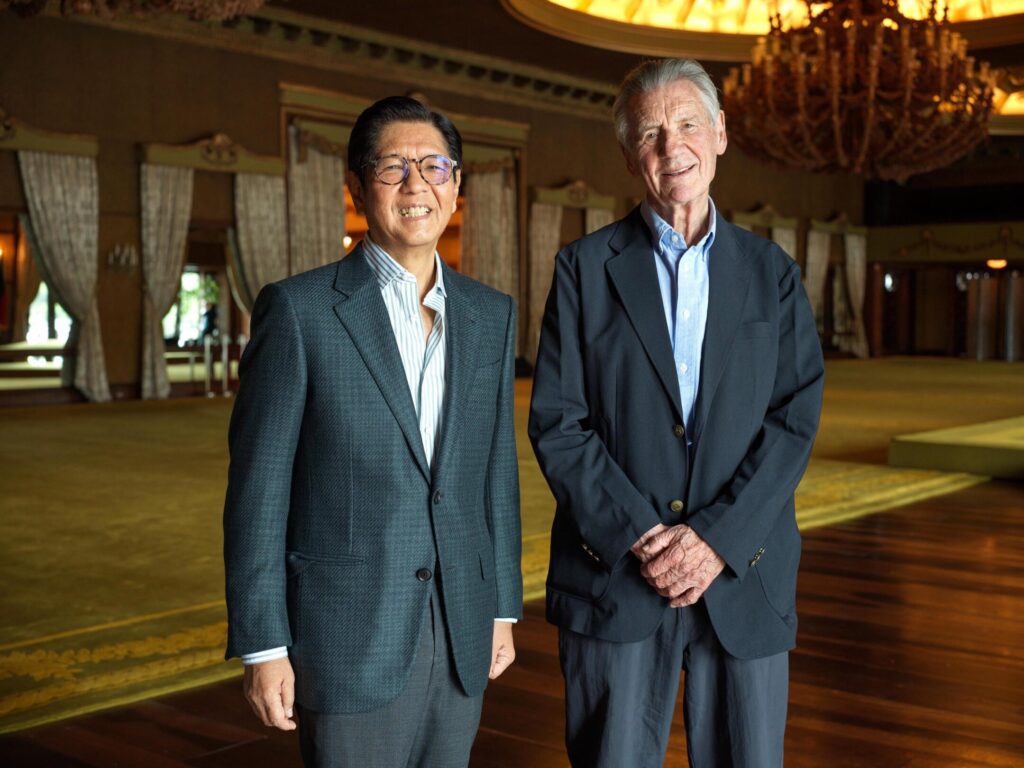
Palin keeps his end of the deal, and the interview is quite light, with Marcos Jr. giving him a tour of Malacañang Palace and fanboying over Palin’s Monty Python days from his student years in the UK (on taxpayers’ public money, as reported before). Palin’s humor shines through when, in a voice-over admiring the Palace’s opulent ceremonial room, he quips that Imelda Marcos “certainly knew how to buy a carpet.”
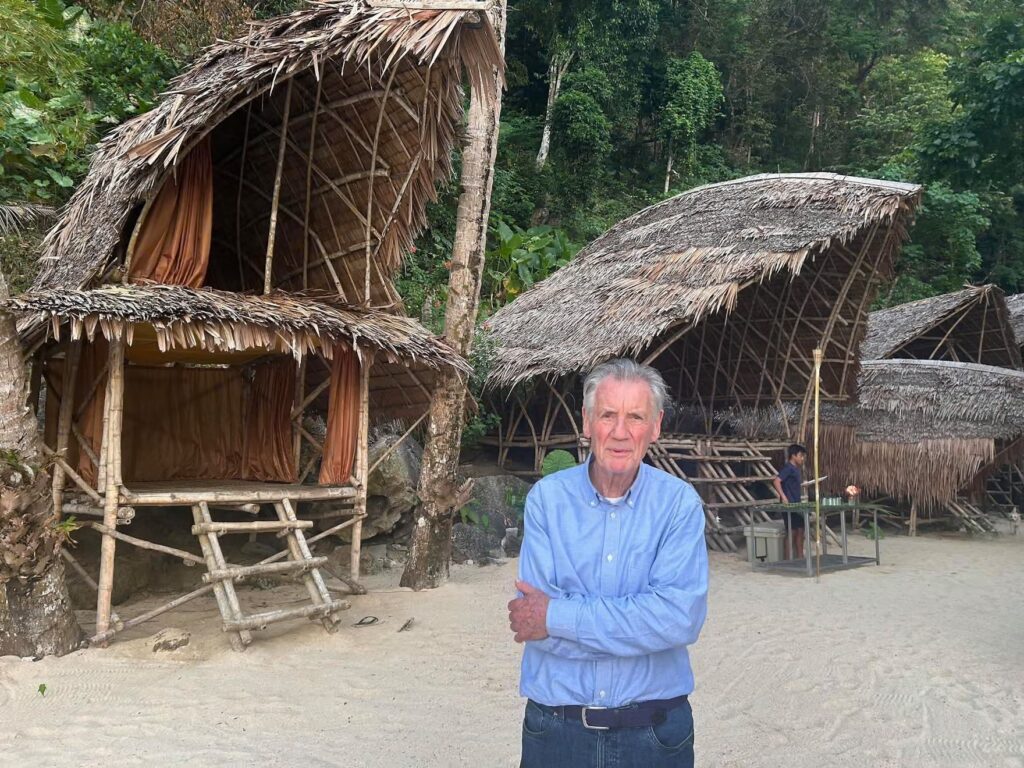
Flying next to El Nido, he marvels at its dramatic limestone cliffs and spends an off-grid night in an unpowered cabin on isolated Cadlao Lagoon. The following day, he flies to Pag-asa Island, the country’s vfrontline in its ongoing territorial dispute with China.

On the island, Palin notes how the threatening fleet of Chinese vessels stands in stark juxtaposition with the locals’ quiet island life. Watching kids dive carefree into the clear waters with the ominous ships in the background is one of the series’ most memorable scenes.
The episode ends with Palin witnessing firsthand a tense, unnerving standoff between Philippine and Chinese coast guard ships.
Related story: Beating the heat: An urban Filipino’s guide to the Super El Niño
Related story: The great AI debate: Hit the brakes or charge ahead?
Episode 2: Paradise calling
Palin starts the second leg of his journey exploring the Puerto Princesa Subterranean River, reputed to be the longest navigable underground river in the world. The whole island is a UNESCO biosphere reserve, but in the town of Brooke’s Point, he sees that its environment is threatened by a huge nickel mine, which is suspected of poisoning the area.
This segment with an indigenous community hit me so hard that I had to pause the episode as my eyes started to well up. Palin and his team show Norima, one of the residents, a drone shot of the nickel mine upstream, which is polluting the river and water sources her community depends on. She is left speechless as the sheer scale of the operation sinks in. I couldn’t help but tear up with her.
From Palawan, Palin flies to Cebu City, the country’s oldest city, and visits Cebu’s dancing inmates at the Cebu Detention and Rehabilitation Center. There he watches hundreds of smiling persons deprived of liberty (PDLs) break into a synchronized dance routine, a glorious yet bizarre sight. But behind the splendid performance, alas, the inmates live in unbelievably cramped cells.
Back in the city, he meets comedian Margie de Leon and learns that the Philippines is one of only two countries where divorce is banned, the other being Vatican City. De Leon’s parents “had a really rocky marriage,” and with dry humor, she notes that her mother’s only way out of the marriage was her father’s death.
Yet, archaic laws are not the only forces trapping Filipinos in precarious lives; the laws of nature offer little refuge either. With climate change fueling ever-stronger typhoons, Palin witnesses the aftermath in Talisay, a Metro Cebu city lashed by catastrophic floods during Typhoon Kalmaegi (Tino) in November 2025. The human tragedy is compounded by institutional failure: journalist Morexette Erram reveals that billions in flood-control funds were lost to corruption instead of protecting vulnerable communities.
The episode ends on a much lighter note in the fishing town of Moalboal, where millions of sardines have settled in the bay. Palin meets freediver Gladys Documento, and the then-82-year-old takes the plunge to see the hypnotic, swirling formations himself, joking afterwards that he lost his dentures in the dive (hehe).
Episode 3: In the shadow of terrorism
The first two episodes tackled difficult topics, but the third carries a heavier pall. Palin begins the final leg of his journey in Mindanao, parts of which (western and central Mindanao and the Sulu archipelago), he notes, are on the UK Foreign Office’s “do not travel” list because of the risk of Islamic terrorism.
The tone is lighter at first: he tries mangosteen and the notoriously putrid durian, though he is spared the smell (or the stench, depending on your preference), having lost his sense of smell a few years ago.

Then comes Marawi, which made world headlines in May 2017 when jihadists and the military clashed in fierce fighting. After five months of gunfire and airstrikes, the city was left a shell of its former self.
There he meets Queenie Pacalundo-Mamacotamo, who has moved back into her damaged house even though her entire street was decimated. She is honoring her father’s final wish: he was an overseas Filipino worker (OFW) in the Middle East, and the house was built on his blood and sweat. It’s another moment that left me in tears.
Next, he passes through Zamboanga City to catch an overnight ferry to Sulu. Under military escort on Jolo, he meets Jabir Latip, an alleged co-founder of Abu Sayyaf who now works with the military. Sitting down with a former member of a group notorious for kidnapping and beheading Westerners takes a particular kind of calm, and this is where Palin’s respectfulness is tested most.
He admits it’s “always very difficult to do an interview like that,” and notes that Jabir “seems to present a somewhat sanitized version of his time with Abu Sayyaf, but he was a key figure in a brutal and barbaric group.” Still, his takeaway shows the wisdom and empathy built over decades of travel to the world’s most difficult corners. He points out that Jabir joined the group at 10, too young to grasp what it meant, and grew up with it as his only source of security.
The episode ends on an optimistic note. Anchored in Jolo’s new tagline “from terrorism to tourism,” Palin waxes poetic about the islands’ stunning natural beauty, which can compete with the Philippines’ best. The series closes at Katribo Slow Coffee Bar, a local favorite that Palin sees as a sign of a “new, younger, and forward-looking Jolo.” Its young owner, Maya, says she and her husband want to show the world that Sulu has “more coffee than chaos,” which is also the café’s tagline.
The last shot has Palin staring out at the Sulu Sea at sunset, noting that the country “has a lot of hope,” especially with its young population. He hopes the Philippines will not just be liked but also “respected as it ought to be.”
Related story: Child support isn’t conditional: What separated parents should know about PH law
Related story: To ban or to balance: How can we protect Filipino kids online without cutting them off?
Beauty and pain in the same frame
“Michael Palin in the Philippines” is a heartfelt and heart-wrenching look at a country famed for both its natural beauty and its deep-seated problems. It may be simplistic, even lazy, to lean on contrasts, but contradiction is simply how the Philippines is.
Palin often finds the beauty and the pain in the same frame: kids diving carefree into clear water with Chinese vessels looming behind them, a prison full of smiling, synchronized dancers who sleep in inhumane cells, a palace tour with the President in one scene and a plate of “recycled chicken” in Tondo in another.
What keeps this from sounding trite is how Palin handles it. He doesn’t treat the country as an exotic postcard or as an exposé. He recognizes the appealing and the unsavory, takes both as real, and gives everyone the same patient curiosity, from the country’s head of state to ordinary Filipinos and a former terrorist. He lets the joy be unbridled without glossing over the pain, and lets the pain stand without reducing Filipinos to victims. His respectful portrayal of ordinary people is the human layer that so many travel shows forget.
By seeing what makes us human and beautiful, “Michael Palin in the Philippines” rises above a typical travel documentary and becomes a deep dive into the heart and soul of an extraordinarily beautiful and complex country. Sir Michael Palin delivers a masterclass in respect, empathy, and curiosity—qualities so sorely lacking in today’s glut of vapid, clout-seeking travel “influencers.”
Palin doesn’t just show us the Philippines; he listens to it, and that makes all the difference.
“Michael Palin in the Philippines” is not yet available in the Philippines, but viewers can watch it on the UK’s Channel 5 using a VPN. Keep an eye out for updates on when it will drop on local streaming platforms.