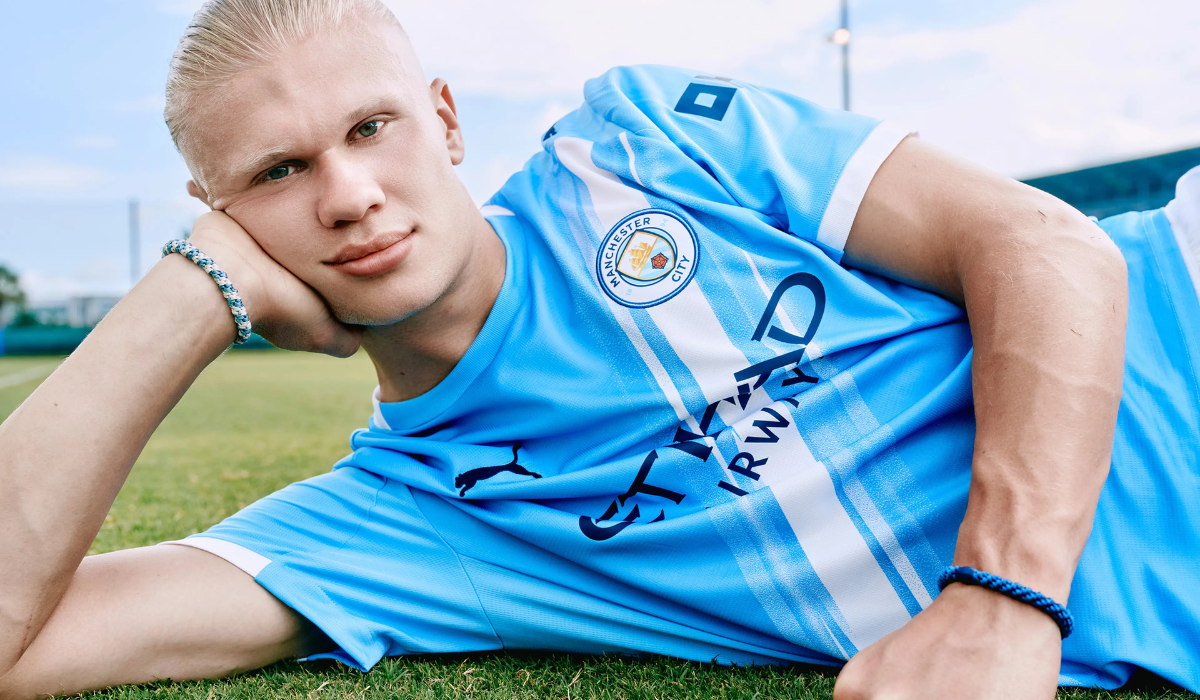

Take a look at the joyfully weird world of football’s most beloved striker: seven goals, a taxidermied raccoon, a $500K Birkin collection, and the internet’s heart.
Most athletes leave the FIFA World Cup with medals, heartbreak, or both. Erling Haaland left America with seven goals, millions of new admirers, a designer travel bag, cowboy boots—and a stuffed raccoon clutching a bottle of whiskey that he carried onto his flight home as if it were another teammate. It is perhaps the most Haaland thing imaginable: he managed to make the biggest headline of his tournament a taxidermied animal.
That is the Norwegian experience in the summer of 2026. Norway’s 25-year-old battering ram of a striker did not win the World Cup. He did not even reach the semifinals, falling to England in extra time on July 11 after inspiring his country’s first quarterfinal run in nearly three decades. However, somewhere between the goals and the goofy Instagram captions, Haaland pulled off something harder than lifting a trophy: he became the Cup’s emotional center of gravity, the football diehards and never-watched-a-match-before civilians alike could not stop watching.
Banner photo by Caroline Tompkins
Suffice to say, in an era where elite athletes are meticulously media-trained and carefully packaged, Haaland has become irresistible precisely because he doesn’t seem interested in tallying perfection points. He laughs at himself, posts whatever he finds amusing, collects luxury handbags without apology, shops for cowboy memorabilia in Texas, and somehow still plays football like a Norse god descending upon defenders.
Norway’s sports machine
Long before Manchester City, Champions League nights, or World Cup heroics, Haaland’s story began in Leeds, England, where he was born while his father, Alf-Inge Haaland, played professional football. The family eventually returned to Bryne, Norway, where a young Erling developed into one of Europe’s most intriguing prospects. His rise then happened in one, big pendulum swing.
There was Bryne FK, then Molde under Ole Gunnar Solskjær. Then came Red Bull Salzburg, where his scoring exploits attracted worldwide attention—just before Borussia Dortmund transformed him into one of football’s deadliest young forwards. By 2022, Manchester City had secured his signature, and the records practically started rewriting themselves. Premier League scoring records tumbled. Defenders struggled to contain a striker who combined sprinter’s speed, wrestler’s strength, and almost supernatural positional awareness.
Yet, even as trophies accumulated, Haaland rarely appeared burdened by expectation. That’s partly because he has repeatedly spoken about playing from a place of enjoyment rather than pressure. His celebrations aren’t declarations of dominance but expressions of childlike delight—as though scoring goals remains, somehow, just as fun as it was in the backyard. That emotional lightness has become one of his greatest competitive advantages, even though his numbers alone would have been enough. His seven goals tied him with Kylian Mbappé and Lionel Messi for the World Cup’s scoring lead—the first time in the competition’s history that three players have each cleared seven in a single edition. His brace against Brazil sent the five-time champions crashing out of the round of 16 and sent Norway into its first-ever World Cup quarterfinal.
What turned him into a breakout star, though, was never just performance. The goals made him famous, but the personality made the internet fall in love. He wandered New York City alone before facing Senegal, genuinely surprised nobody stopped him for a selfie; he stopped into Katz’s Delicatessen like a tourist on a lunch break; he posted dry, deadpan captions that turned casual fans into newly minted football converts. Everybody was smitten at the sight of him.
Also, when Norway’s team returned to Oslo after the England defeat, more than 100,000 people flooded the streets for a heroes’ welcome for a team that, on paper, had merely lost. That is not a normal reaction to a quarterfinal exit. That is what happens when a country falls for how a player carries himself, not just what he does with a football.
Football’s golden retriever
There is a curious contradiction at the heart of Erling Haaland. On the pitch, he resembles a Viking warrior programmed solely to score. Off it, he behaves more like everyone’s impossibly tall golden retriever friend. Throughout the World Cup, social media became filled with clips of Haaland joking with strangers, pretending to be Norway’s “social media guy,” wandering around places with genuine curiosity, speaking in playful accents, and posting raw, unfiltered glimpses into tournament life. Rather than carefully curated sponsorship posts, followers found infrared sauna selfies, restaurant visits, and moments that do not read as a script.
Fans accustomed to polished celebrity branding discovered someone whose most attractive asset might just be downright authenticity. He doesn’t appear interested in seeming mysterious, he doesn’t cultivate untouchability, and he lets people in. All of a sudden, everything weird about this guy became an instant fan magnet.
World Cup’s Birkin viking
Then there’s the fashion.
If the raccoon was an accident of tournament tourism, Haaland’s other great off-pitch fascination is anything but casual. Over the past several years, and especially during this World Cup season, the towering Norwegian has slowly built one of the most eye-catching handbag collections in sports—reportedly worth somewhere between $300,000 and $500,000, depending on which appraisal you trust.
Fashion enthusiasts have identified rare Haut à Courroies models, limited-edition designs, and highly coveted Hermès pieces worth tens of thousands of dollars each. During the Cup, he was photographed carrying extraordinary bags that generated almost as much conversation as his goals. Analysts estimate that his collection is worth hundreds of thousands of dollars, making him one of football’s most unexpected luxury style icons.
In another sporting phenomenon or World Cup timeline, male athletes carrying Birkins might have been treated as novelty. Today, Haaland wears them with such utter confidence that the bags have become another extension of his personality: playful, unconventional, and entirely unconcerned with expectations. It isn’t fashion for attention; it’s fashion because he likes it, and that difference matters.
The Quarterfinal bromance
Long before Norway and England landed in the same World Cup bracket, Erling Haaland and Jude Bellingham were teenagers together at Borussia Dortmund, and the friendship they built there—low-key texts, forwarded memes, a “good luck” before big matches and a “well done” after—never really faded, even after Haaland moved to Manchester City and Bellingham to Real Madrid.
So when the two sides met in the quarterfinal on July 11, football media couldn’t resist framing it as a breakup match, complete with the expected pre-kickoff hug and a “peck on the cheek for old times’ sake.” Bellingham’s England won it in extra time, ending Norway’s run, and the friendship seemed to survive the result exactly as advertised—one more reminder that Haaland’s whole disposition toward the game looks like genuine affection first, ruthless competition second.
Haaland’s newest fur-team
While Norway’s squad based itself stateside for the tournament, Haaland made a stop at Wild Bill’s Western Store in Dallas. He emerged with what may be the most talked-about souvenir of the entire World Cup: a $750 preserved raccoon, mounted on a wooden board, posed as if nuzzling an empty liquor bottle. Store staff nicknamed it the “Whiskey Raccoon.” When Haaland deplaned in Oslo on July 13 carrying it through the airport like hand luggage, photos went everywhere-viral—trending enough that the U.S. Transportation Security Administration felt compelled to issue an official statement clarifying that yes, taxidermy raccoons clutching empty bottles are permitted on flights. Undeniably, this may be the only time in World Cup history that a player could turn airport arrivals into a massive lifestyle content.

Haaland, delighted, asked fans to help him name his new companion, running an Instagram poll with options including Cowboy, Ranger, TEX, and—in a nod to Norway’s team boat-rowing celebration ritual—”R.O.W.” The store back in Dallas reported the raccoon’s understudies sold out within hours of the photos hitting social media. It is, by any measure, one of the most eccentric footnotes to a World Cup run in recent memory—the kind of unique that could only belong to someone who has stopped worrying about looking cool and started just doing what genuinely amuses him.
The footballer’s 6,000-calorie daily diet
None of this looseness happens by accident. Underneath the raccoon and the Birkins is one of the most rigorously engineered daily routines in professional sport.
Haaland treats sleep less like rest and more like a training discipline. He aims for close to ten hours a night, wears orange-tinted, blue-light-blocking glasses for hours before bed to protect his melatonin, and has admitted—memorably, on Logan Paul’s podcast—to sleeping with his mouth taped shut to encourage nasal breathing through the night. Mornings begin around 8:30 with direct sunlight in his eyes, a habit borrowed from circadian-rhythm science meant to anchor his body clock. He filters his own drinking water and reportedly stirs collagen into his coffee at breakfast alongside milk and maple syrup.
His diet leans hard into old-fashioned Norwegian tradition rather than the sports-science orthodoxy of endless chicken and rice: organ meats like heart and liver, wild-caught fish, quality dairy, root vegetables, minimally processed everything. Before home matches, he still eats a homemade lasagna cooked by his father—a ritual so beloved that Pep Guardiola has reportedly joked about trying to poach Haaland’s dad to cook for the whole Manchester City squad. Recovery, meanwhile, borders on the industrial: ice baths, sauna-and-cold contrast therapy, red-light treatment, daily physio, and a personal cryotherapy chamber at home. Teammate Jack Grealish once summed it up plainly: “He does everything. Recovers, in the gym, ten hours of treatment a day, ice baths, diet.”
Even the hair is a system. Haaland’s high, slicked ponytail—dubbed the “Erling Knot”—became its own minor World Cup subplot, spawning tutorials across TikTok and Instagram from fans desperate to replicate it. The bobbles holding it in place come from a small Norwegian brand called KKNEKKI, of which Haaland is reportedly now a minority owner, having become enough of a devotee to buy into the company itself.
The striker formula
It would be simple to write Haaland off as an athlete with quirky hobbies bolted onto elite talent—the goals are real, and the eccentricities are garnish. The joy is not decoration on top of the competitive edge; it looks, more and more, like the engine of it. A player who tapes his mouth shut at night, eats liver because his body performs better on it, and still finds room to buy a taxidermied raccoon on a whim and carry a $50,000 handbag through an airport is a player who has figured out how to take the whole enterprise seriously without ever once seeming to take himself too seriously.
Norway went home without a trophy. Haaland went home with a raccoon, an expanding handbag collection, seven goals, and, improbably, more new fans than nearly anyone else in the tournament. In a sport that so often rewards seriousness, he made a compelling case that lightness might be its own competitive advantage—and that the most heartthrob thing a striker can do isn’t brooding intensity at all. It’s clearly—and visibly—having the time of his life.
Related story: Meet the 5 highest-paid football players in the world right now
Related story: If every country welcomed home its losing team like Norway did, the world would be a better place